TPS –
focused pulses deep into the network
“There is nothing more we can do” is, in Alzheimer’s, a sentence about the limits of medication, not about the person you are worried about. TPS sends short, focused pressure pulses with millimetre precision into defined brain regions, including deeper areas that magnetic coils cannot reach, and has its strongest data in Alzheimer’s dementia. What part of that makes sense for one particular person is settled by the assessment, with imaging, findings and a conversation to which relatives expressly belong.
TPS is a non-invasive procedure that works with single, very short focused shockwaves, that is with acoustic pressure pulses rather than magnetic fields or current. The pulses pass through the skull with little discomfort and act at a chosen target point a few millimetres across. Because a pressure pulse can be focused, TPS also reaches structures that lie too deep for rTMS.
Our device: Storz Neurolith
The mechanism, made clear
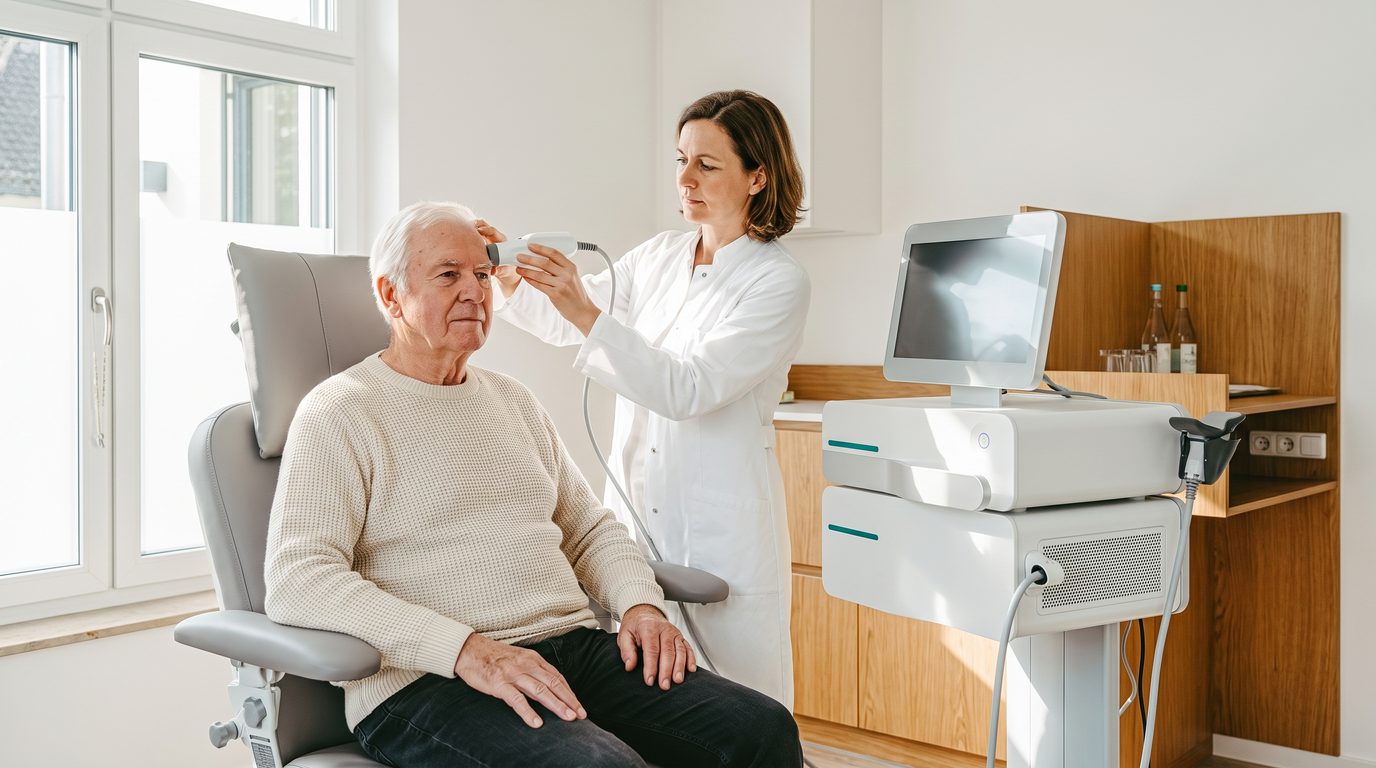
On the Storz Neurolith the physician guides an ergonomic hand applicator along the head; an infrared camera and a tracking system link the applicator in real time to your MRI dataset, so the target region is approached under navigation. Each pulse briefly generates mechanical forces in the tissue (mechanotransduction), which can stimulate the release of growth and vascular factors and perfusion and thereby support neuroplasticity. Which regions we approach follows from the assessment: imaging, neurological findings, questionnaires and, where the question calls for it, a qEEG.
For us, TPS is above all a way to regulate functional balance without adding medication — with the aim of restoring function and quality of life.
What to expect
You sit relaxed; a gel couples the applicator to the scalp. A session lasts about 30 minutes, and a series usually comprises several sessions over two to three weeks. With each pulse you feel a short, light tap; occasionally mild transient headache, a feeling of pressure or tiredness occurs. No anaesthesia is needed, and you can resume your day straight away. Our observation in early dementia: in some people with early dementia, changes over the course show first in drive and mood and only later in the memory tests; this matches the studies on depression in Alzheimer’s. It is one of the reasons we pair TPS with movement, sleep and inflammation diagnostics, including where large trials of the combination are missing, as an individual, informed treatment attempt, and let each course inform the next concept.
TPS is CE-certified for the treatment of Alzheimer’s dementia; for other indications such as depressive symptoms or autism spectrum conditions we use it off-label, as an individual, informed treatment attempt, when the assessment and the medical judgement support it. With us, TPS is one tool among several. Nerve cells are the most energy-hungry cells in the body, and an inflammation that keeps running in the body reaches the brain through messenger molecules; that is why inflammation markers, the energy supply of the mitochondria and sleep belong in the same plan as the pulses.
See all conditions — and what fits you is decided by the assessment, with qEEG where the question calls for it.
What the research shows
Peer-reviewed work on TPS (Transcranial Pulse Stimulation) — graded by evidence level. No study proves an individual outcome.
Ultrasound Neuromodulation With Transcranial Pulse Stimulation in Alzheimer Disease: A Randomized Clinical Trial
Transcranial pulse stimulation in Alzheimer’s disease
Neuromodulatory Effects of Transcranial Pulse Stimulation (TPS) in Neurological and Psychiatric Disorders – A Systematic Review and Meta-Analysis
Ultrasound neuromodulation as a novel dementia therapy – Investigation of possible long-term confounds
Transcranial pulse stimulation (TPS) improves depression in AD patients on state-of-the-art treatment
Antidepressant effect of transcranial pulse stimulation (TPS) targeting neuropsychiatric disorders: a retrospective analysis
Effects of transcranial pulse stimulation on autism spectrum disorder: a double-blind, randomized, sham-controlled trial
Evaluating the Safety and Efficacy of Transcranial Pulse Stimulation on Autism Spectrum Disorder: A Double-Blinded, Randomized, Sham-Controlled Trial
More: Science & Studies.
For TPS in Alzheimer’s there is a randomised clinical trial, alongside clinical studies and a meta-analysis across neurological and psychiatric indications; in depression and autism the evidence is still young. Which areas we approach and what is treated beside the pulses follows your findings, and the course is re-measured.
Part of Clinicum St. Georg, under the medical direction of Dr. med. univ. Julian Douwes. Outpatient, evidence-graded, tailored to your profile. More on our program.
TPS (Transcranial Pulse Stimulation): is it right for you?
The assessment decides, not a brochure. We clarify it in a free consultation, with no obligation and full confidentiality.