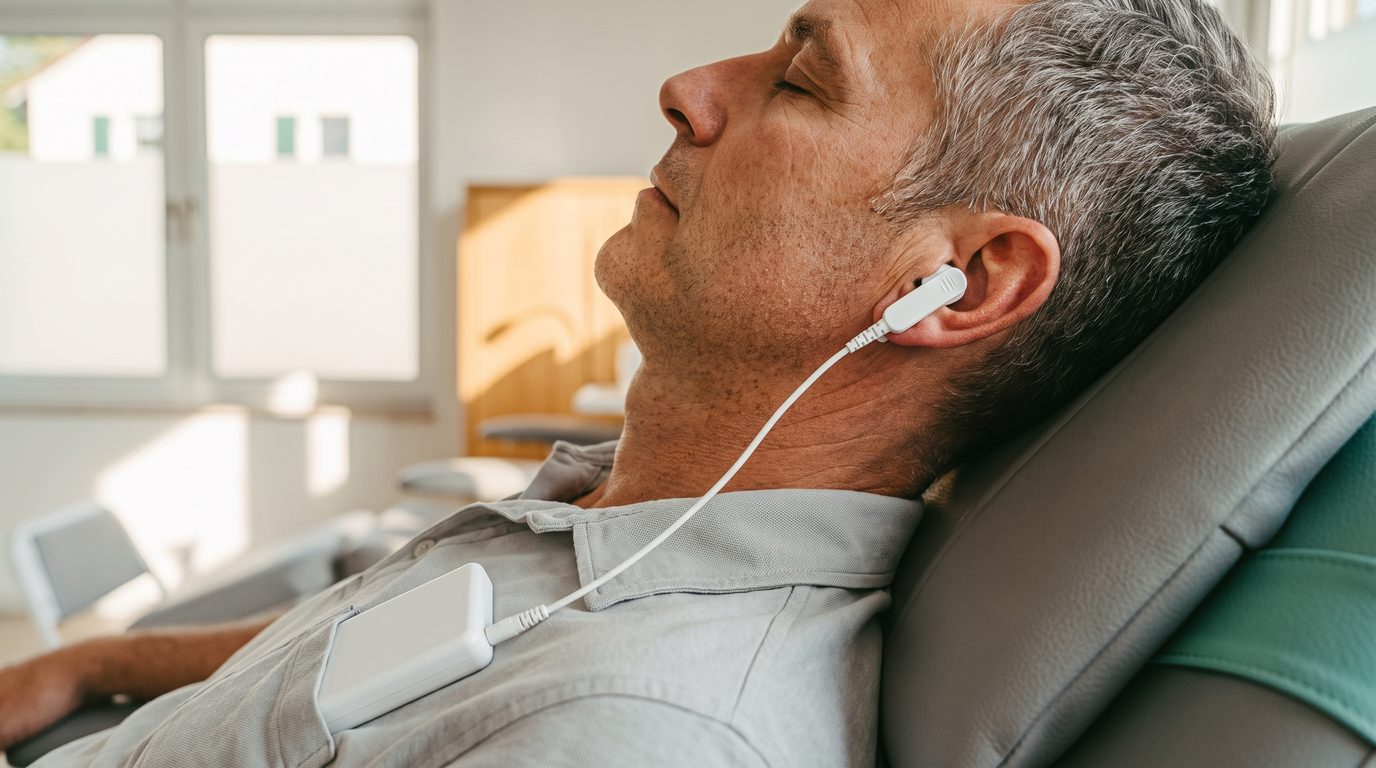
taVNS – reaching the vagus nerve
gently through the ear
The vagus nerve is the brake of the nervous system, and in many people after an infection or under chronic stress nobody has pressed it in years. taVNS reaches this nerve through a small electrode at the ear, with no surgery and no needles. Whether the brake is your problem is shown by heart rate variability in the assessment, before we stimulate.
taVNS is the non-invasive form of vagus nerve stimulation. Instead of an implanted device it uses an ear electrode on the outer ear (concha/tragus), where a sensory branch of the vagus nerve runs just beneath the skin. A small stimulator delivers gentle electrical pulses, and the nerve carries them on to the brainstem. That makes the vagus reachable without anyone needing surgery.
Our device: Ohrelektrode (aurikuläre taVNS)
The mechanism, made clear
The vagus nerve is the central link between brain and body and a main regulator of the parasympathetic nervous system, the system of rest and recovery. Via the auricular branch at the ear, the pulses travel to the nucleus tractus solitarii in the brainstem and from there into networks that help regulate mood, stress processing and attention, among them the limbic and the salience network. We set intensity and frequency so that it is noticeable but not painful. For us, taVNS is a building block, not a program: the gut talks to the brain through this very nerve, and an infection that keeps the immune system running sends inflammatory signals along the same route; that is why gut diagnostics and infection and inflammation markers sit in the same plan as the ear electrode, and the assessment says beforehand whether the vagus is the right starting point at all.
For us, taVNS is above all a way to regulate functional balance without adding medication — with the aim of restoring function and quality of life.
What to expect
A session lasts 20 to 60 minutes; you sit relaxed while the ear electrode produces a light tingling or pulsing at the ear. Possible, mostly mild side effects are local tingling, redness or a feeling of pressure at the ear, rarely mild headache or dizziness; pre-existing conditions such as certain cardiac arrhythmias are clarified by Dr. med. univ. Julian Douwes before the first use. What we see in post-infectious courses: in Long COVID and ME/CFS, taVNS rarely stands alone with us, and where heart rate variability moves over the course, it is usually where sleep and a source of inflammation were worked on at the same time. So we use taVNS as part of a combination, tailored to the person and as an informed treatment attempt, and the courses we see shape the next concept.
Within our program, taVNS comes into question in depression, anxiety, migraine, epilepsy, in sleep and stress concerns, and in the autonomic dysregulation that follows infections, for example in Long COVID. For these indications we use taVNS as an individual, informed treatment attempt, usually alongside other building blocks of the plan.
See all conditions — and what fits you is decided by the assessment, with qEEG where the question calls for it.
What the research shows
Peer-reviewed work on taVNS (Transcutaneous Auricular Vagus Nerve Stimulation) — graded by evidence level. No study proves an individual outcome.
Efficacy and safety of taVNS in the treatment of depressive disorder: a systematic review and meta-analysis of RCTs
Transcutaneous auricular vagus nerve stimulation for post-stroke depression: a double-blind, randomized, placebo-controlled trial
taVNS for treatment of drug-resistant epilepsy: a randomized, double-blind clinical trial
Transcutaneous auricular vagus nerve stimulation for epilepsy
Transcutaneous auricular vagus nerve stimulation (taVNS) for migraine: an fMRI study
Safety of transcutaneous auricular vagus nerve stimulation (taVNS): a systematic review and meta-analysis
Transcutaneous auricular vagus nerve stimulation in insomnia: a systematic review and meta-analysis
Clinical efficacy of auricular vagus nerve stimulation in the treatment of chronic and acute pain: a systematic review and meta-analysis
taVNS as a novel therapy connecting the central and peripheral systems: a review
Critical review of transcutaneous vagus nerve stimulation: challenges for translation to clinical practice
More: Science & Studies.
For taVNS there are randomised trials and meta-analyses, for instance in depression, epilepsy and insomnia; protocols and effect sizes still differ from study to study. We set intensity, frequency and duration to your response and follow heart rate variability over the course.
Part of Clinicum St. Georg, under the medical direction of Dr. med. univ. Julian Douwes. Outpatient, evidence-graded, tailored to your profile. More on our program.
taVNS (Transcutaneous Auricular Vagus Nerve Stimulation): is it right for you?
The assessment decides, not a brochure. We clarify it in a free consultation, with no obligation and full confidentiality.