How does rTMS work?
From the magnetic coil to the nerve cell
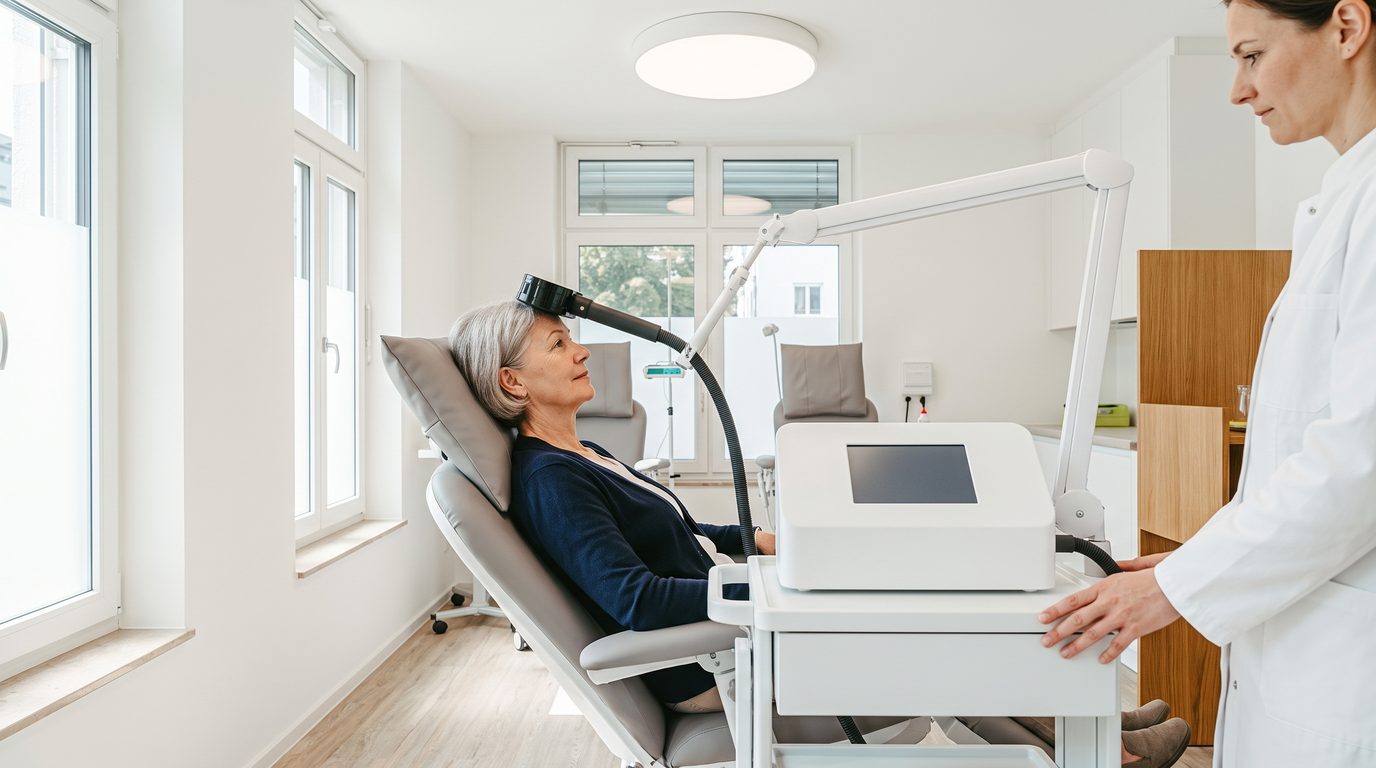
rTMS (repetitive transcranial magnetic stimulation) works through brief, strong magnetic pulses emitted by a coil resting against the outside of the head, which induce small electrical currents in the brain tissue beneath. These currents prompt nerve cells to fire; over many repetitions, the activity and connectivity of a targeted region can be re-tuned. It is non-invasive, with no surgery and no anaesthesia; you stay awake throughout. The stimulus the coil delivers is the one nerve cells use anyway: an electrical impulse, only this time from the outside and aimed precisely where a network has gone quiet.
Last updated: 2026-07-25 · Medically reviewed by Dr. med. univ. Julian Douwes
The core principle: a magnetic field becomes current
rTMS rests on a basic law of physics (electromagnetic induction): a rapidly changing magnetic field generates an electrical current in a conductor. Here, the “conductor” is your brain tissue. For fractions of a second the coil produces a strong magnetic field that passes unhindered through skin and skull, unlike an electric current, which would be blocked by the scalp.
Directly beneath the coil, this field induces a small current flow that depolarises nerve cells (neurons) at that spot, making them fire. This does not stimulate the whole brain, but targets a region near the surface.
The figure-8 coil on the MagVenture X100
The coil’s shape is decisive for precision. We use a figure-8 coil on the MagVenture X100. In this design the magnetic fields of two round coils overlap exactly at the centre, where the induced field is strongest. This focuses the stimulus onto a relatively confined region rather than spreading it broadly.
The coil sits on an articulated support arm and is positioned precisely over the target area, for depression usually over the left dorsolateral prefrontal cortex. Which region is right for you is something we decide only after measuring, not by a fixed template.
Why many sessions? Neuroplasticity
A single pulse only briefly makes a nerve cell fire. The real effect comes from repetition: “repetitive” is in the name. Depending on frequency, rTMS can raise the excitability of a region (higher frequencies) or dampen it (lower frequencies).
Across many pulse trains and several sessions, the way a region works and connects with others can change more durably, this “relearning” is called neuroplasticity. That is why classic rTMS runs over several weeks. Modern accelerated protocols (theta-burst) compress many sessions into a few days.
What does a session feel like?
You sit comfortably in a treatment chair; the coil rests against the outside of your head. A classic session lasts roughly 20–40 minutes depending on protocol, while theta-burst protocols take only a few minutes. You hear a rhythmic tapping and feel a tapping or tingling on the scalp, sometimes a slight twitch of the facial or forehead muscles.
The most common side effect is temporary headache or scalp tenderness. Seizures are very rare, which is why we carefully check contraindications (e.g. metal implants in the head) beforehand. Afterwards you can immediately resume your day; no recovery time is needed.
What can rTMS help with, and what not?
rTMS is best evidenced for depression, especially when medication has not helped enough. Further indications with growing to solid evidence include obsessive-compulsive disorder, anxiety disorders, chronic pain syndromes and motor rehabilitation after stroke.
rTMS is among the best-studied neuromodulation methods; not everyone responds the same way, studies describe averages, your course is individual. We summarise the evidence transparently on our Science & Studies page; how the method fits our overall concept is shown in Our Program. For more detail on the procedure and indications, see the rTMS treatment page.
Frequently asked questions
Is rTMS the same as electroconvulsive therapy (ECT)?
No. rTMS is not electroconvulsive therapy. No current passes through your body, you receive no anaesthesia, and no seizure is induced. You are awake and responsive throughout the entire session.
Can I feel the magnetic pulses in my brain?
The brain itself has no pain receptors, so you do not feel the stimulus “inside your head”. What you notice is the rhythmic tapping of the coil, a tingling on the scalp and sometimes a slight facial muscle twitch.
Why do I need several weeks of treatment?
Because the lasting effect arises through repetition and neuroplasticity; a single pulse is not enough. Classic protocols run over weeks; accelerated protocols compress this into a few days.
How do you know exactly where to stimulate?
From the assessment. Before rTMS we bring history, findings and clinical examination together into one picture; where the question calls for it, qEEG brain mapping is added to refine the target region and protocol. Only from that do we derive where and how to stimulate.
Read more
Similar articles
An article does not know your findings.
What fits you is shown by the structured assessment. The free consultation takes 15 to 20 minutes and clarifies whether this path is worth it for you.