rTMS –
targeted where the network is out of rhythm
For most people with depression, what has been treated so far is the chemistry of the brain, never the brain itself. rTMS changes that: magnetic pulses reach the prefrontal cortex, which is measurably underactive in depression, as an outpatient and without anaesthesia, and it is recommended in the German S3 guideline. Whether it is the right starting point for you is settled by the assessment before the first session.
rTMS (repetitive transcranial magnetic stimulation) is a non-invasive neuromodulation procedure: a pulsed magnetic field passes through the skull and activates or dampens nerve cells, usually in the prefrontal cortex. In treatment-resistant depression, rTMS is recommended in clinical guidelines; treatment runs as outpatient session series, without anaesthesia and without adding medication.
rTMS has been approved for depression in the United States since 2008 and is among the most thoroughly studied neuromodulation methods. Brief magnetic pulses change the activity of a targeted brain region; depending on the frequency, the region is activated or dampened. It has nothing in common with electroconvulsive therapy: no seizure, no anaesthesia, and you stay awake and responsive for the whole session.
Our device: MagVenture X100
The mechanism, made clear
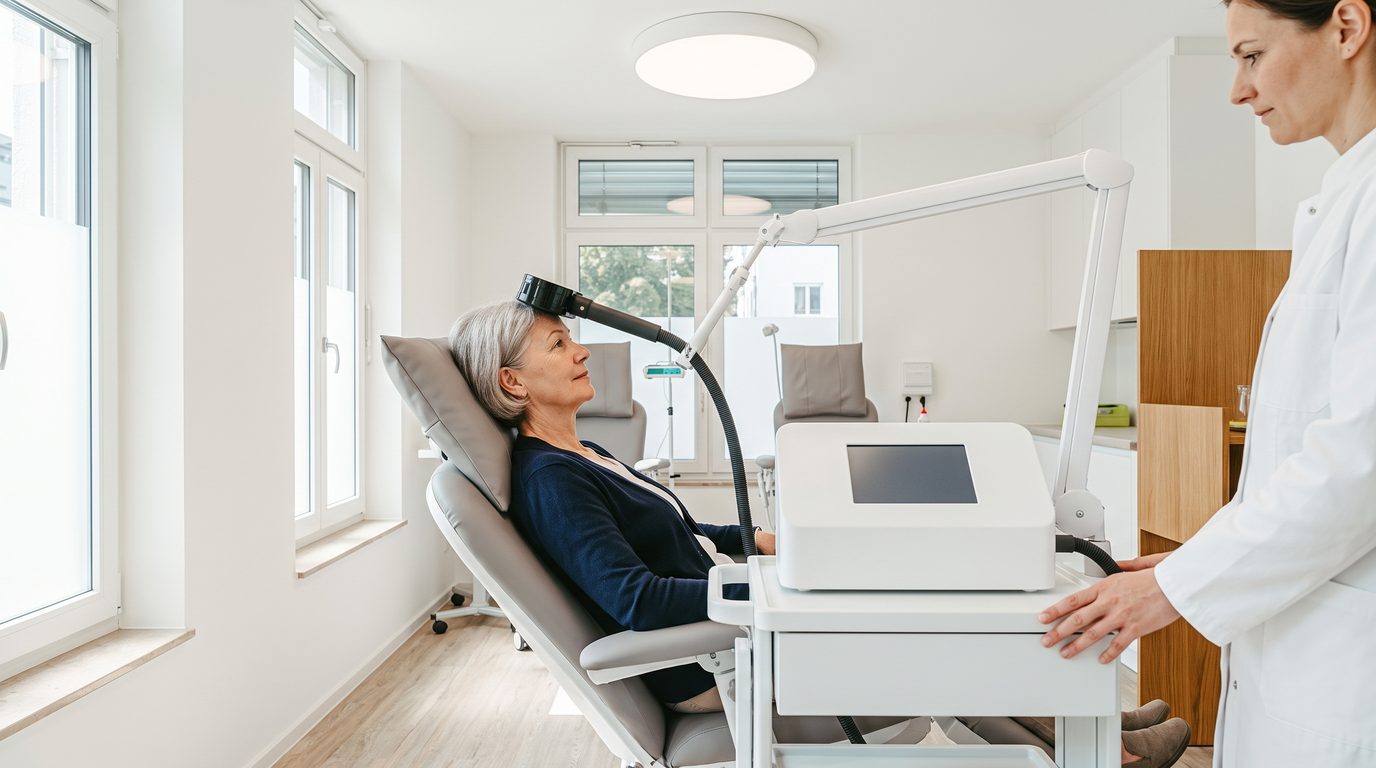
On our MagVenture X100 we position a figure-8 coil on the articulated support arm over the target area; in depression that is usually the left dorsolateral prefrontal cortex. The rapidly changing magnetic field induces small currents in the tissue beneath, and the nerve cells fire. Repeated over weeks, the activity and connectivity of the region re-tune; that is neuroplasticity, the same capacity the brain uses whenever it learns. Where the coil sits and which frequency we use follows from the assessment, with a qEEG where the question calls for it.
For us, rTMS is above all a way to regulate functional balance without adding medication — with the aim of restoring function and quality of life.
Pause
What to expect
You sit in a treatment chair with the coil resting against the outside of your head. A classic session lasts 20 to 40 minutes depending on the protocol, a theta-burst protocol only a few minutes. You hear a rhythmic tapping and feel it on the scalp; sometimes the forehead muscles twitch along. The most common side effect is a temporary headache or a tender scalp; seizures are very rare, which is why we screen for contraindications such as metal in the head beforehand. Afterwards your day carries on as normal. What we observe in the clinic: in a subset of people who respond hesitantly to rTMS alone, the course changes once the thyroid, sleep or a source of inflammation is treated alongside. Studies describe what works on average across many people; the person in front of us is not an average. So we combine methods the way the assessment suggests, as an informed treatment attempt, and what we see feeds into every concept that follows.
rTMS is best evidenced for depression, above all when medication has not helped enough. With growing to solid evidence come obsessive-compulsive disorder, anxiety disorders, chronic pain syndromes and motor rehabilitation after stroke; for depression and neuropathic pain there are guideline recommendations, and beyond those we use rTMS as an individual, informed treatment attempt. With us, rTMS is one building block among several: an underactive prefrontal cortex in someone with an untreated underactive thyroid is a thyroid case first, and lived experience measurably changes the wiring, which is why labs, hormone status and psychological support belong in the same plan as the coil. Treatment is outpatient in Bad Aibling, TMS therapy near Munich, about 50 minutes via the A8.
See all conditions — and what fits you is decided by the assessment, with qEEG where the question calls for it.
What does a rTMS course with us look like?
First consultation
Free of charge: we go through your concern, prior treatments, medication and contraindications and tell you whether rTMS is an option for you at all. Book a consultation.
Assessment
Before any stimulation we take stock: history, existing findings, questionnaires, clinical examination and, where needed, labs and imaging. qEEG brain mapping is added when the question calls for it.
Target & protocol
We define the target region, the frequency and your stimulation intensity (motor threshold), and decide between a classic 10 Hz series, iTBS or, in suitable cases, the accelerated protocol.
Treatment series
Typically 20 to 30 sessions on five days a week: 20 to 40 minutes at 10 Hz, a few minutes with iTBS. The accelerated protocol compresses several sessions a day into about five days.
Progress measurement
Questionnaires during the series, then the comparison with your baseline, with a qEEG check where needed. From that we adjust the protocol and plan maintenance sessions if they are needed.
Which conditions is rTMS evidenced for?
Evidence grade, typical protocol and context — per indication. Scale: strong · solid · moderate · growing · early. A high grade describes the state of the research, not your individual course.
| Indication | Evidence grade | Typical protocol | Note |
|---|---|---|---|
| Depression | Strong | 10 Hz left DLPFC or iTBS · 20–30 sessions over 4–6 weeks | Best evidence of all indications; recommended in guidelines when medication has not helped enough. |
| Treatment-resistant depression | Strong | Standard series or accelerated iTBS (SNT-type, approx. 5 days) | Primary indication. Response is individual and measured throughout. |
| OCD | Solid | Deep TMS / high-frequency over mPFC–ACC or low-frequency over the SMA · 20–30 sessions | Meta-analyses show moderate effects; adjunct to behavioural therapy. |
| Chronic (neuropathic) pain | Solid | High-frequency over the motor cortex (M1) contralateral to the pain · series + maintenance | Guideline recommendation for neuropathic pain; weaker evidence for other pain types. |
| Tinnitus | Moderate | 1 Hz over the auditory cortex · 10–20 sessions | Effects small and heterogeneous; case-by-case decision, not a standard. |
| Long COVID – fatigue & brain fog | Early | High-frequency left DLPFC · usually 10–20 sessions (pilot protocols) | First small studies; off-label, only after thorough informed consent. |
| Negative symptoms of schizophrenia | Moderate | High-frequency left DLPFC · 15–20 sessions | Network meta-analysis with small to moderate effects; adjunct to standard psychiatric care. |
| Stroke rehabilitation (motor) | Solid | 1 Hz over the unaffected or high-frequency over the affected hemisphere · paired with physiotherapy | Added effect on top of training in meta-analyses; courses vary widely. |
Who should not have rTMS?
We screen for contraindications in the first consultation, before any protocol is planned. rTMS is not suitable — or only after individual medical review — in case of:
- Ferromagnetic metal in the head (e.g. vascular clips, shrapnel, cochlear implant): absolute contraindication
- Implanted electronic devices (pacemaker, defibrillator, neurostimulator, drug pump): only after individual review
- Epilepsy or a history of seizures: increased risk, strict assessment
- Pregnancy: case-by-case decision
- Acute severe physical illness or an unstable cardiovascular situation
- Medication or substances that lower the seizure threshold, and acute withdrawal: only after review
- Children and adolescents: only after special medical consideration
How much does rTMS cost?
We provide rTMS for self-paying and privately insured patients; German statutory insurers so far cover outpatient rTMS only in exceptional cases after an individual application. The price depends on the protocol and the number of sessions, and 20 to 30 sessions is a realistic planning basis. What a single session costs, how series are built and how a reimbursement application works is explained in our article TMS therapy cost & insurance; you leave the first consultation with a concrete cost plan.
What the research shows
Peer-reviewed work on rTMS (Repetitive Transcranial Magnetic Stimulation) — graded by evidence level. No study proves an individual outcome.
Effectiveness of theta burst versus high-frequency rTMS in depression (THREE-D): a randomised non-inferiority trial
Effects of rTMS of the left dorsolateral prefrontal cortex on symptom domains in neuropsychiatric disorders: a systematic review and cross-diagnostic meta-analysis
Recovering from depression with repetitive transcranial magnetic stimulation (rTMS): a systematic review and meta-analysis
Transcranial Magnetic Stimulation and Transcranial Direct Current Stimulation Across Mental Disorders: A Systematic Review and Dose-Response Meta-Analysis
Theta burst stimulation for depression: a systematic review and network and pairwise meta-analysis
A Meta-analysis of Transcranial Magnetic Stimulation in Obsessive-Compulsive Disorder
Repetitive Transcranial Magnetic Stimulation for Obsessive-Compulsive Disorder: A Meta-analysis of Randomized, Sham-Controlled Trials
Safety and recommendations for TMS use in healthy subjects and patient populations: Expert Guidelines
Evidence-based guidelines on the therapeutic use of repetitive transcranial magnetic stimulation (rTMS): an update (2014–2018)
Repetitive transcranial magnetic stimulation for motor recovery after stroke: a systematic review and meta-analysis of randomized controlled trials with low risk of bias
Assessment of noninvasive brain stimulation interventions for negative symptoms of schizophrenia: a systematic review and network meta-analysis
Effect of repetitive transcranial magnetic stimulation on long coronavirus disease 2019 with fatigue and cognitive dysfunction
More: Science & Studies.
Questions about rTMS, answered briefly
What is rTMS?
How many rTMS sessions are needed?
How long does rTMS last?
Is rTMS painful?
What are the side effects of rTMS?
Does health insurance pay for rTMS?
rTMS or ECT – what is the difference?
Does rTMS help with anxiety?
Where can I get rTMS near me?
Who should not have rTMS?
rTMS for depression is backed by randomised trials, meta-analyses and guidelines, and still not everyone responds the same way. Your protocol follows your findings, and we measure the course instead of waiting out thirty sessions.
Part of Clinicum St. Georg, under the medical direction of Dr. med. univ. Julian Douwes. Outpatient, evidence-graded, tailored to your profile. More on our program.
rTMS (Repetitive Transcranial Magnetic Stimulation): is it right for you?
The assessment decides, not a brochure. We clarify it in a free consultation, with no obligation and full confidentiality.