Accelerated TMS –
more sessions, condensed into a few days
Travelling in every day for six weeks is the reason many people with depression never start an rTMS series. Accelerated TMS packs the same number of short iTBS sessions into a few days, following the pattern developed at Stanford. Whether the compressed schedule fits your findings is decided by the assessment; your calendar only decides whether it is feasible for you.
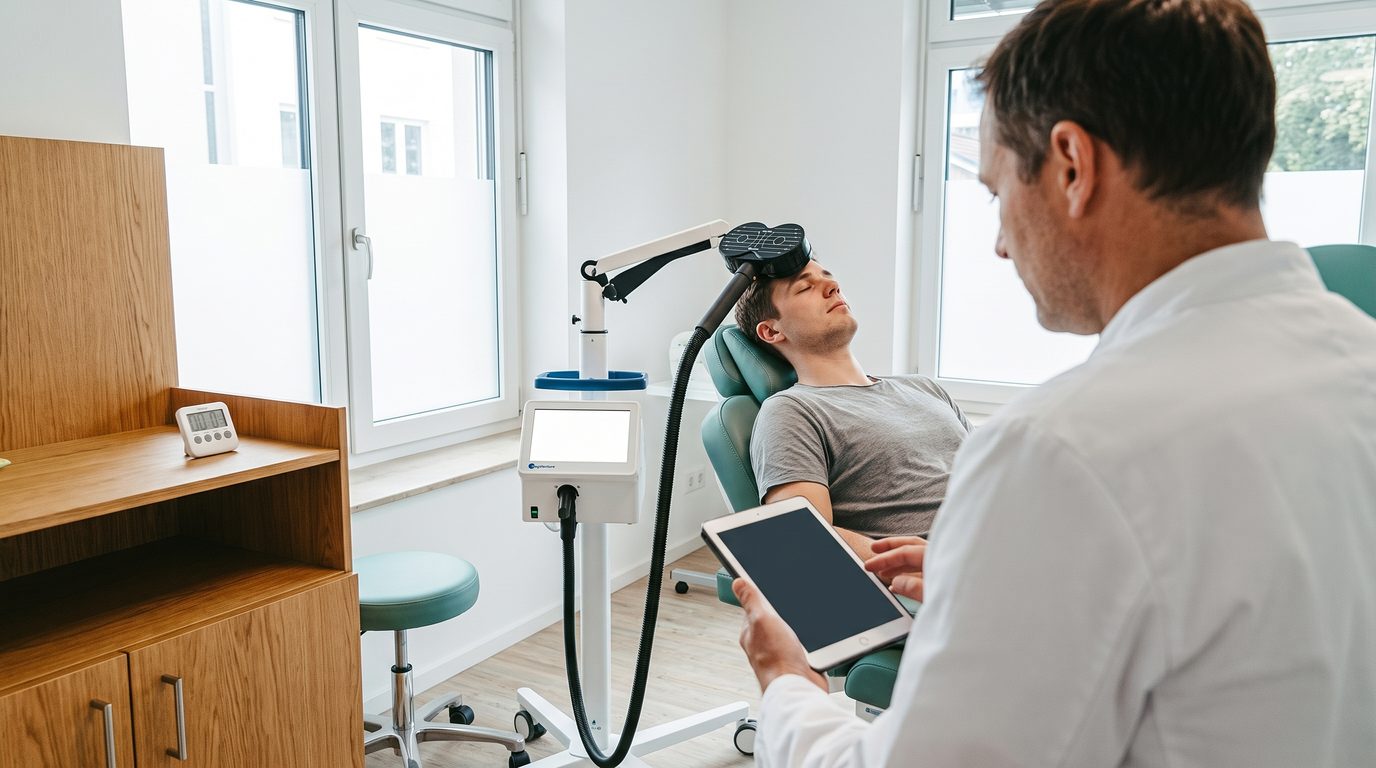
Accelerated TMS runs on the same device as classic rTMS; what is new is the schedule. Instead of one session a day over four to six weeks, you receive several short sessions a day over a few days. It almost always uses intermittent theta-burst stimulation (iTBS), a very short pulse pattern that imitates the theta rhythm of the brain and proved equivalent to the classic 10 Hz series in a large comparative trial.
Our device: MagVenture X100
The mechanism, made clear
Here too we work with the MagVenture X100 and the figure-8 coil on the articulated arm. iTBS delivers short bursts of high-frequency pulses in a theta rhythm; one session lasts only a few minutes, so up to ten sessions with breaks can be stacked within a single day. The SNT pattern from Stanford additionally sets the target by functional connectivity, so the coil points more precisely at the part of the prefrontal cortex wired to the affected network. Which targeting makes sense for you follows from the assessment.
For us, Accelerated TMS / iTBS is above all a way to regulate functional balance without adding medication — with the aim of restoring function and quality of life.
Pause
What to expect
A treatment day consists of several short sessions with breaks in between, usually on five consecutive days. Each session feels like classic TMS: rhythmic tapping, a tingling on the scalp, quiet in between. The compressed form is more demanding per day and shortens the overall period from weeks to days; side effects match classic TMS, that is headache, scalp tenderness and very rarely a seizure, which is why contraindications are checked in advance. What we see after such series: the days after the series count for the course as much as the series itself. So we plan sleep, the alignment of medication with your treating physicians and the follow-up measurement before you travel in, and we use the compressed form the way your findings suggest, as an individual, informed treatment attempt whose course we document.
The focus of the research is on depression, above all treatment-resistant courses and rapid relief of acute symptoms; early data also exist for bipolar depression. The SNT protocol has been cleared in the United States since 2022. Compressed or classic is, with us, a question of your findings and your life situation, and either one is only part of the plan: five days with many pulses are a high dose for a network, and what holds the gains is often what sits beside them. Sleep that can be measured and treated, and psychological support, because relationships and lived experience keep changing the wiring, therefore belong in the same plan as the five days.
See all conditions — and what fits you is decided by the assessment, with qEEG where the question calls for it.
What the research shows
Peer-reviewed work on Accelerated TMS / iTBS — graded by evidence level. No study proves an individual outcome.
Stanford Neuromodulation Therapy (SNT): A Double-Blind Randomized Controlled Trial
Stanford Accelerated Intelligent Neuromodulation Therapy for Treatment-Resistant Depression
Accelerated Theta-Burst Stimulation for Treatment-Resistant Depression: A Randomized Clinical Trial
Connectivity-guided intermittent theta burst versus repetitive transcranial magnetic stimulation for treatment-resistant depression: a randomized controlled trial
Accelerated Intermittent Theta-Burst Stimulation and Treatment-Refractory Bipolar Depression: A Randomized Clinical Trial
Accelerated TMS for Depression: A systematic review and meta-analysis
Short-term and long-term efficacy of accelerated transcranial magnetic stimulation for depression: a systematic review and meta-analysis
Accelerated bilateral theta burst stimulation for suicidal ideation in depression
More: Science & Studies.
Randomised trials show rapid effects of accelerated iTBS in treatment-resistant depression; long-term and comparative data are still maturing. Compressed or classic is decided on your findings, and we check the course after the series.
Part of Clinicum St. Georg, under the medical direction of Dr. med. univ. Julian Douwes. Outpatient, evidence-graded, tailored to your profile. More on our program.
Accelerated TMS / iTBS: is it right for you?
The assessment decides, not a brochure. We clarify it in a free consultation, with no obligation and full confidentiality.