What happens at a qEEG appointment
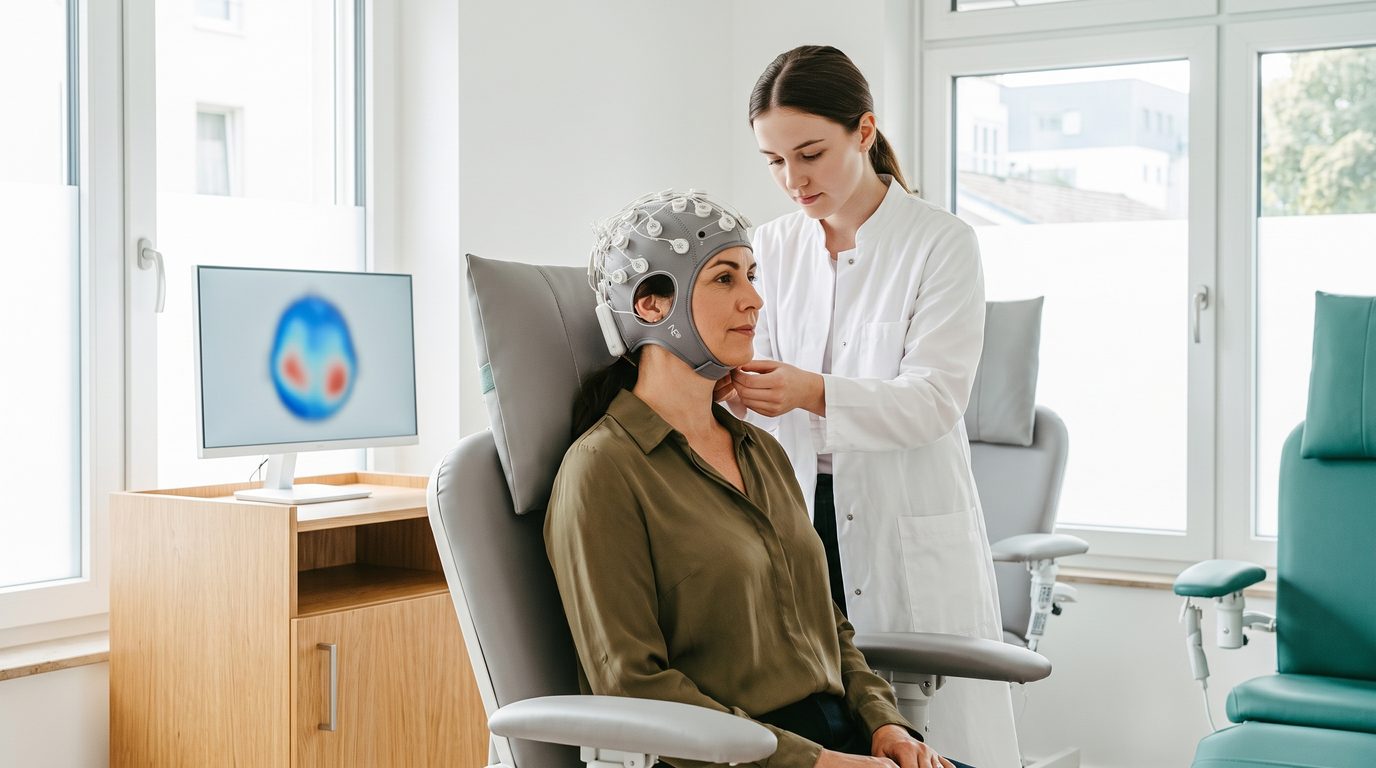
If we suggest a qEEG brain mapping, there is a reason: your question calls for a look at the brain networks that the conversation, questionnaires and examination alone cannot give. The appointment itself is undramatic. You wear a soft cap with 32 electrodes, sit quietly for about 60 minutes, and the device listens. No radiation, no injection, no current. Afterwards we analyse the recording and explain what your network picture shows, and what it does not.
Last updated: 2026-07-25 · Medically reviewed by Dr. med. univ. Julian Douwes
What a qEEG is – briefly
qEEG stands for quantitative electroencephalogram: we measure the electrical activity of your brain at the scalp and compare it computationally with a normative database. This makes visible which brain networks tend to be over- or under-active in you. The qEEG is a diagnostic method: it measures, it does not treat. Nor is it compulsory. Every patient starts with a structured assessment of history, existing findings, questionnaires and clinical examination; whether a qEEG is added is decided after that.
Important: the qEEG alone does not make a diagnosis. A physician combines it with your history, clinical assessments and further building blocks into an overall picture. More on our diagnostics page.
How to prepare
Preparation is straightforward. Most helpful is:
- Freshly washed hair without gel, oil or hairspray – this improves electrode contact.
- Arriving well rested where possible; extreme sleep deprivation can alter the picture.
- Avoiding a lot of caffeine immediately beforehand.
- Mentioning any medication in advance – you should not stop anything on your own, but we take its influence into account.
You need do nothing else and bring nothing but yourself. After the appointment you can resume your day straight away.
The process – step by step
- Arrival & briefing: we explain the process and answer questions.
- Fitting the cap: you wear a soft electrode cap; a conductive gel ensures good contact. We use a modern 32-channel system (Enobio 32).
- Resting-state measurement: you sit relaxed, usually alternating between closed and open eyes.
- Task measurement: simple tasks (e.g. quiet focusing) show how your networks behave under load.
- Removal & cleaning: the cap is taken off; the gel washes out easily.
The measurement itself takes about 60 minutes. You feel nothing – the EEG only listens; there is no current, no magnetic pulses, no radiation.
Does it hurt? Is it safe?
No, a qEEG does not hurt. The electrodes only pick up your brain’s natural electrical signals – they emit nothing. There are no needles, no current and no radiation. Some find the gel or the cap slightly unfamiliar, nothing more. The method is well suited to children and older people too, and can be repeated as often as needed.
This is precisely why we also use the qEEG for progress monitoring: we can measure again after a treatment phase and see whether and how your network picture has changed.
What happens with the results?
After the measurement, the data are processed and compared with a normative database. A physician reads the pattern together with your complaints, your history and the other findings from the assessment. If there is a starting point, a treatment proposal that fits your network picture follows; if there is none, we tell you that too.
We discuss the findings with you in plain language: what stands out, what it means and what options there are. Whether and how to proceed is your decision. The first step is the free consultation, 15 to 20 minutes, with no obligation.
Frequently asked questions
How long does a qEEG take?
Does a qEEG hurt?
How do I prepare for the appointment?
Does the qEEG give me a diagnosis?
Can a qEEG be repeated?
Does every patient get a qEEG?
Read more
Similar articles
An article does not know your findings.
What fits you is shown by the structured assessment. The free consultation takes 15 to 20 minutes and clarifies whether this path is worth it for you.