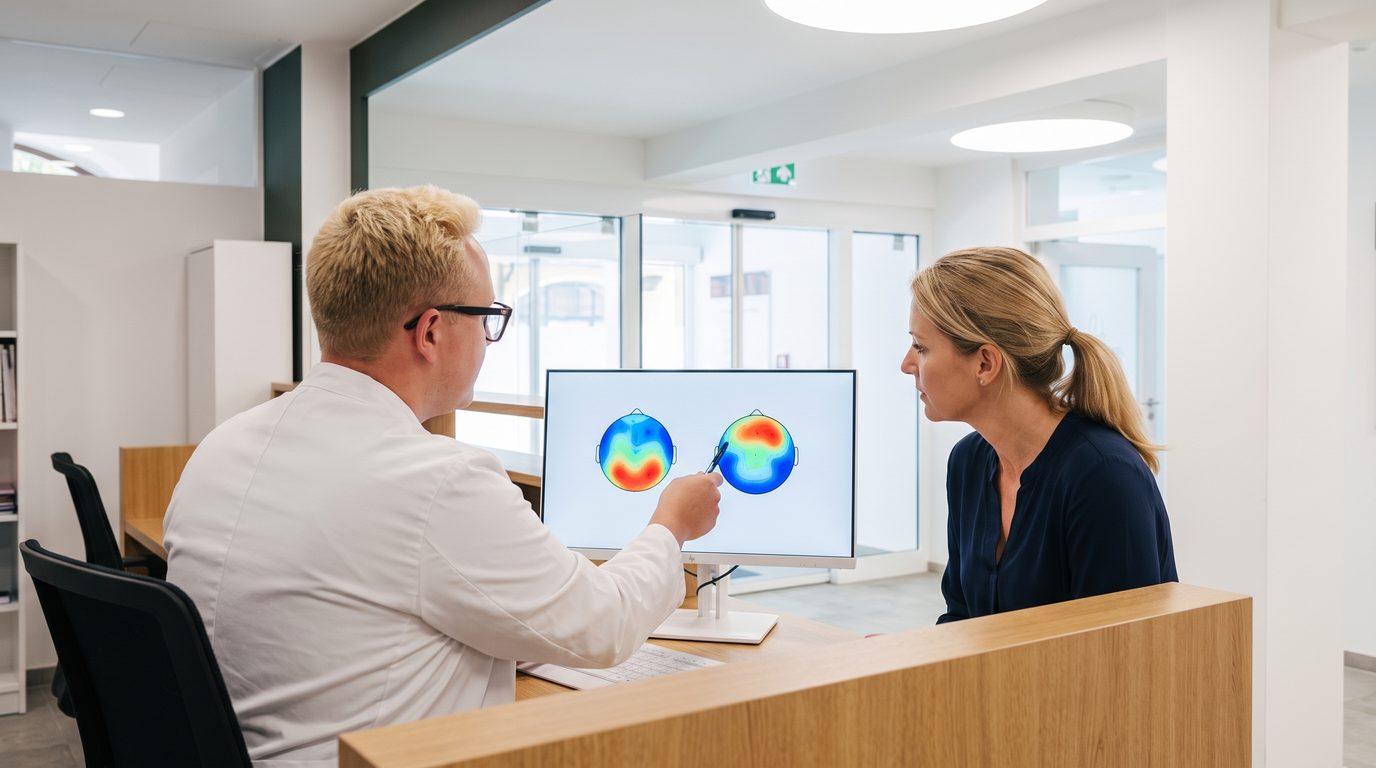
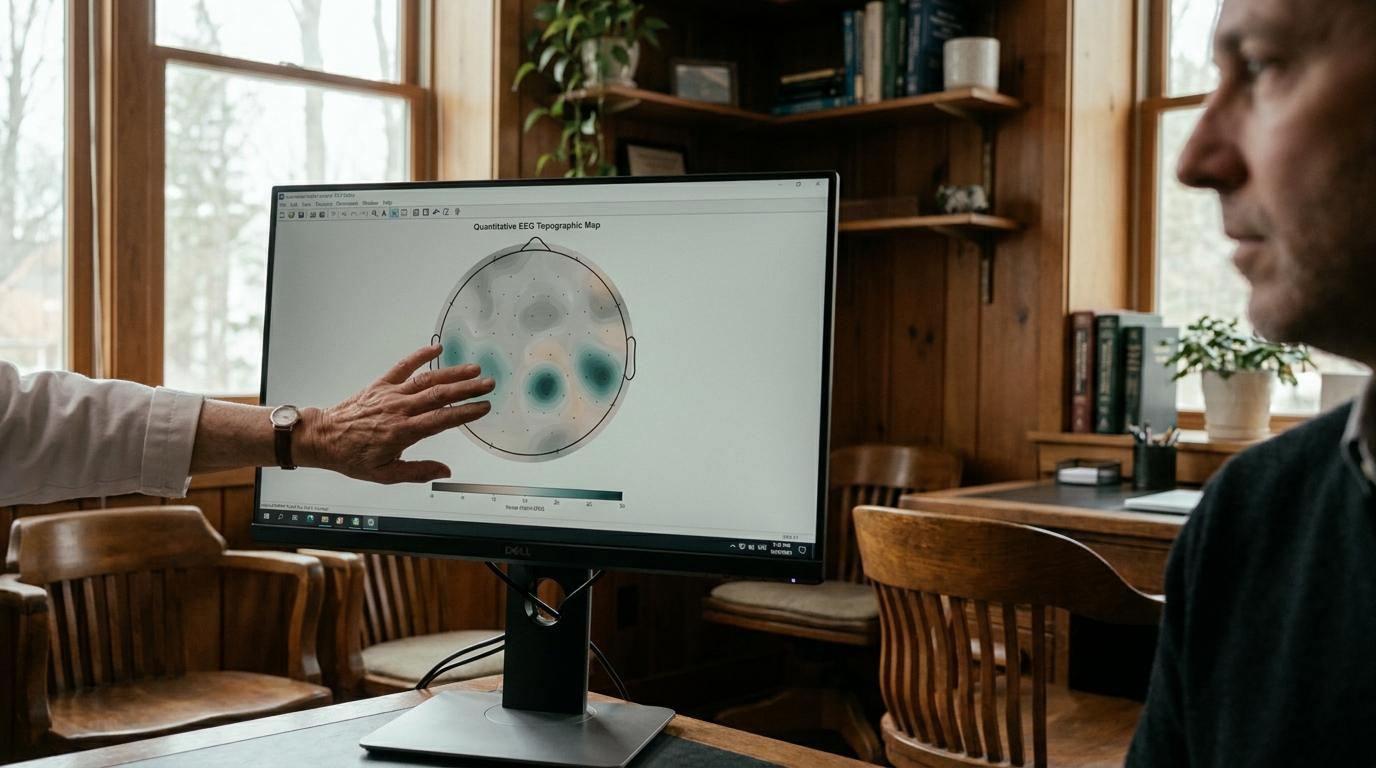
Dr. med. univ. Julian Douwes in conversation with a patient at the wooden table of a treatment room at Clinicum St. Georg, papers and glasses on the table.
The method

We measure first,
then we treat what the findings show.

A diagnosis tells you what you have. The assessment tells you what, in your case, is out of rhythm, in the brain and in the body. We treat the second.

Why a diagnosis is not enough

Same diagnosis, two different brains.

A diagnosis sorts symptoms. “Depression” describes what you experience: mood, drive, sleep. It says nothing about which network in your brain is producing it. Two people with the same word in their referral letter can look completely different in their findings, and usually they do.

In one, the prefrontal cortex has gone quiet. In the other, the default mode network will not switch off at night. Both receive the same diagnosis and, often, the same prescription. Treatment aimed at the diagnosis treats them alike. Treatment aimed at the findings treats two different things. That is the whole difference, and it can be made visible before we recommend anything.

The difference

We measure first. Then we treat.

Measuring, for us, means a structured assessment: your history, existing findings, questionnaires, the clinical examination, and where needed lab work and imaging. Whether qEEG brain mapping is added follows from that. The aim behind it is always the same: to restore the functional balance of brain and body. A network that has gone quiet, a rhythm that has slipped, a regulatory loop that no longer holds: we want to bring that back into order, as far as possible without drugs. We work with as little medication as we can and rely instead on measurement, neuromodulation, regulation and training. The yardstick is not a lab value but how you get through your day.

What goes into your program follows what you are missing, never which device happens to be free. The body has a say in that. Nerve cells are the hungriest cells in the body for energy; when the mitochondria stall after an infection or under chronic stress, network performance drops before any image shows it. The autonomic nervous system and the brain’s networks form one control loop; heart rate variability and qEEG show two sides of the same state. And what a person has lived through measurably rewires connections, which is why psychological care is part of the concept and never an afterthought. rTMS, TPS or neurofeedback are therefore building blocks, never programs in themselves. Non-invasive, outpatient, and without medication as the first step.

Medicine, graded by evidence.

What we do

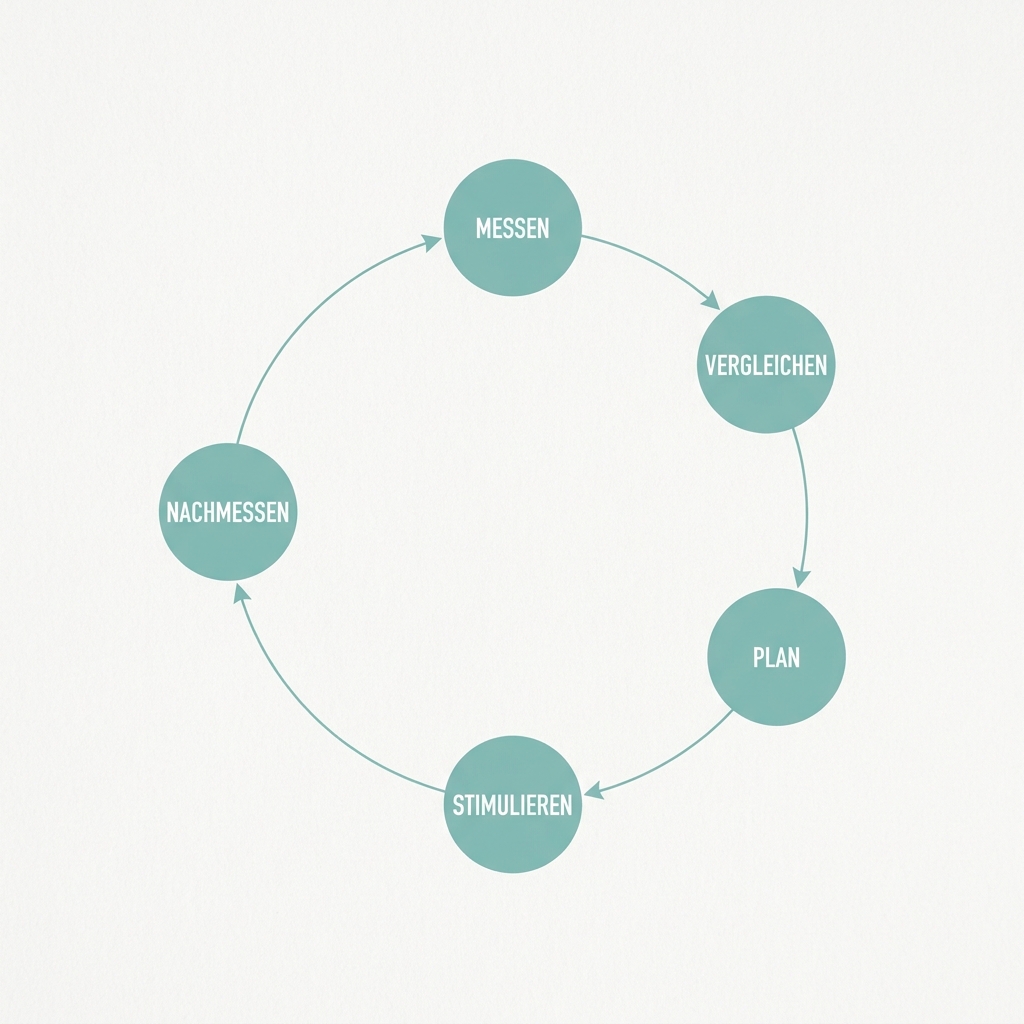
Five steps — one closed loop

One loop: measure, compare, plan, treat, re-measure. Each step works with your own readings, from diagnostics to treatment, and the last step decides the next.

The closed loop of our method: measure, compare, plan, stimulate, re-measure.
01Assessment · several layers

We make visible what is out of rhythm for you

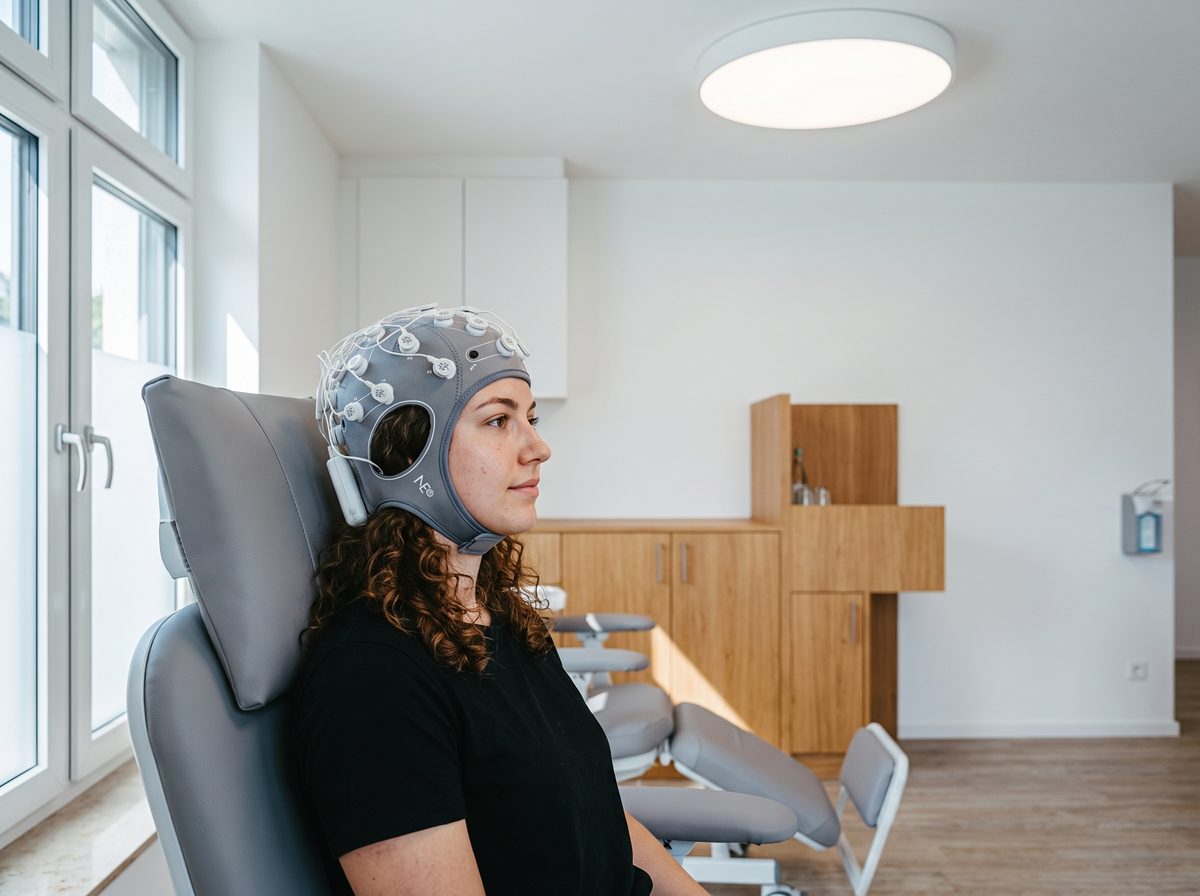
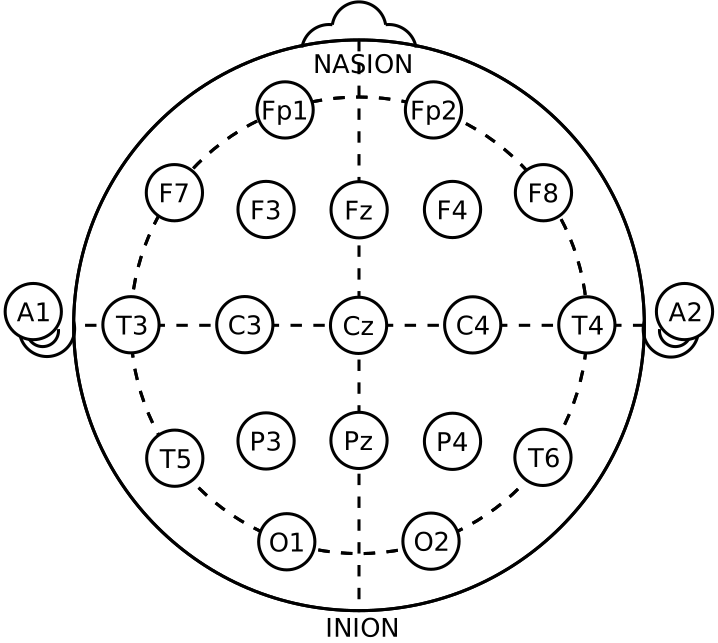
The assessment comes first: your history, existing findings, questionnaires, a clinical examination, and where needed lab values and imaging. If the question calls for a qEEG, we record with 32 electrodes how your brain works at rest, eyes open and eyes closed; painless, no radiation, no procedure. From these layers we build your findings.

Assessment · not a therapy
02Compare

We compare instead of guessing

Questionnaires and lab values have reference ranges, and a qEEG, if one was recorded, is compared with data from thousands of healthy brains of your age. That shows what deviates: an inflammatory marker that will not settle, a region working too slowly, a network that talks too little to the others. We explain every finding on your own results, in plain language.

Reference ranges · normative database
03A plan along your findings

We plan along your findings

Your findings become a plan that follows a fixed chain: symptom, network, region, method. The target is the network in which the symptom arises. Every proposed procedure carries its evidence grade, so you know what you are agreeing to.

Symptom → Network → Region → Method
04Stimulate gently, non-invasively

We treat gently, on an outpatient basis

Only now do we treat, with non-invasive neuromodulation: rTMS, tDCS, taVNS or neurofeedback, depending on what the findings show. No surgery, no anaesthesia, no medication as the first step. You sit in a treatment chair and drive home afterwards.

Outpatient · non-invasive
05Re-measure

We measure the progress, not the hope

After treatment we measure again. Validated symptom scales and, where a qEEG stood at the start, a follow-up qEEG show what has changed, in the same findings as at the start. The plan follows that result. If a network does not respond, we change the target or the method instead of simply running the series to its end.

Follow-up · stated
Where complaints arise

Six networks — one rhythm

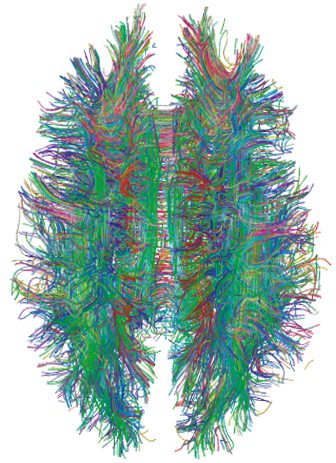
Your brain works in six functional networks: the default mode network for rest and inward attention, the salience network that decides what matters right now, the executive network for planning and control, plus attention, emotion and sensorimotor control. In health they take turns: the default mode network steps back as soon as the executive network takes over. Complaints usually arise where that handover fails, when the default mode network will not switch off at night, or the salience network flags too many signals as important.

That is exactly what a qEEG shows, when it is added: which network is too loud, too quiet, or poorly connected to the others. How the six networks work together, and what happens when one falls out of step, is described in detail under brain networks. For a first impression of which networks appear strained for you, the Brain Network Analysis offers an orientation, not a diagnosis. What the assessment shows afterwards becomes your program.

Take the Brain Network AnalysisOur program
Evidence grades

Medicine, graded by evidence.

Not every procedure is equally well documented. Every procedure in our portfolio therefore carries its current evidence level, in three grades. You decide on the basis of your findings and that grade, not on the basis of a brochure.

Evidence: Strong

Procedures with a robust study base, meta-analyses and, in some cases, regulatory clearance. rTMS in treatment-resistant depression is in the guidelines.

View rTMS →

Evidence: Growing

Procedures with an expanding but not yet settled evidence base, such as taVNS or tDCS. We tell you what is established and what is still open.

View taVNS →

Evidence: Limited

Early procedures we use only adjunctively and after detailed informed consent, such as photobiomodulation.

View procedure →

A trial reports what worked on average across its participants. You are one person, and no average. So we combine methods the way the assessment suggests, including where the large trials do not yet exist, as an individual, informed treatment attempt. What we observe in the clinic along the way shapes every concept that follows.

What the procedures do not do

What neuromodulation can — and cannot — do

Neuromodulation works on the activity of networks. Four points about that which you should know before the first consultation.

  • It does not replace necessary care. Neuromodulation can ease symptoms and support function; how far shows in the follow-up. Necessary specialist or psychotherapeutic care continues alongside, and we never change your medication without your treating physicians.
  • A qEEG measures; it does not treat. When it is added, brain mapping interprets and provides part of the basis for the decision. A physician reads the map together with history, examination and lab values, never on its own.
  • We also say no. If the assessment shows nothing that makes a procedure sensible, or the evidence for your case is too thin, we do not recommend it and tell you what could be considered instead.
  • Off-label is stated. Procedures beyond their approval are used only after detailed informed consent, as an individual treatment attempt, documented and with the evidence grade named.
Why us

One physician, one clinic, one clear stance

The method has a name behind it: Dr. med. univ. Julian Douwes, Chief Medical Officer of the Douwes Brain Center. He is responsible for the measurement-based approach in this clinic and puts his name to it.

The Douwes Brain Center is part of Clinicum St. Georg in Bad Aibling, founded in 1991. From that origin comes the stance: measure precisely, claim only what the follow-up shows, put the person before the method. Patients travel to us from more than 90 countries.

Years of clinical heritage
Countries patients travel from
Procedures in our portfolio
Treatment sessions delivered
All statements on efficacy are based on peer-reviewed studies and clinical guidelines; the current evidence level is stated on every treatment page. Outcomes are individual.

Begin with the assessment

In a free first consultation, 15 to 20 minutes with our medical team, we hear your story and tell you which parts of the assessment apply to you and whether a qEEG belongs in it. You leave with a clear answer.

Book a free consultation +49 (0)8061 398-0
CallBook a free consultation