Neurofeedback –
helping the brain learn to regulate
A brain that sees its own activity on a screen can learn to change it. That is the principle of neurofeedback, and in ADHD it is as well studied as almost any other training. We record with 32 channels, choose the protocol from your findings, and Dr. med. univ. Julian Douwes reads the course; no current flows, and no medication is added.
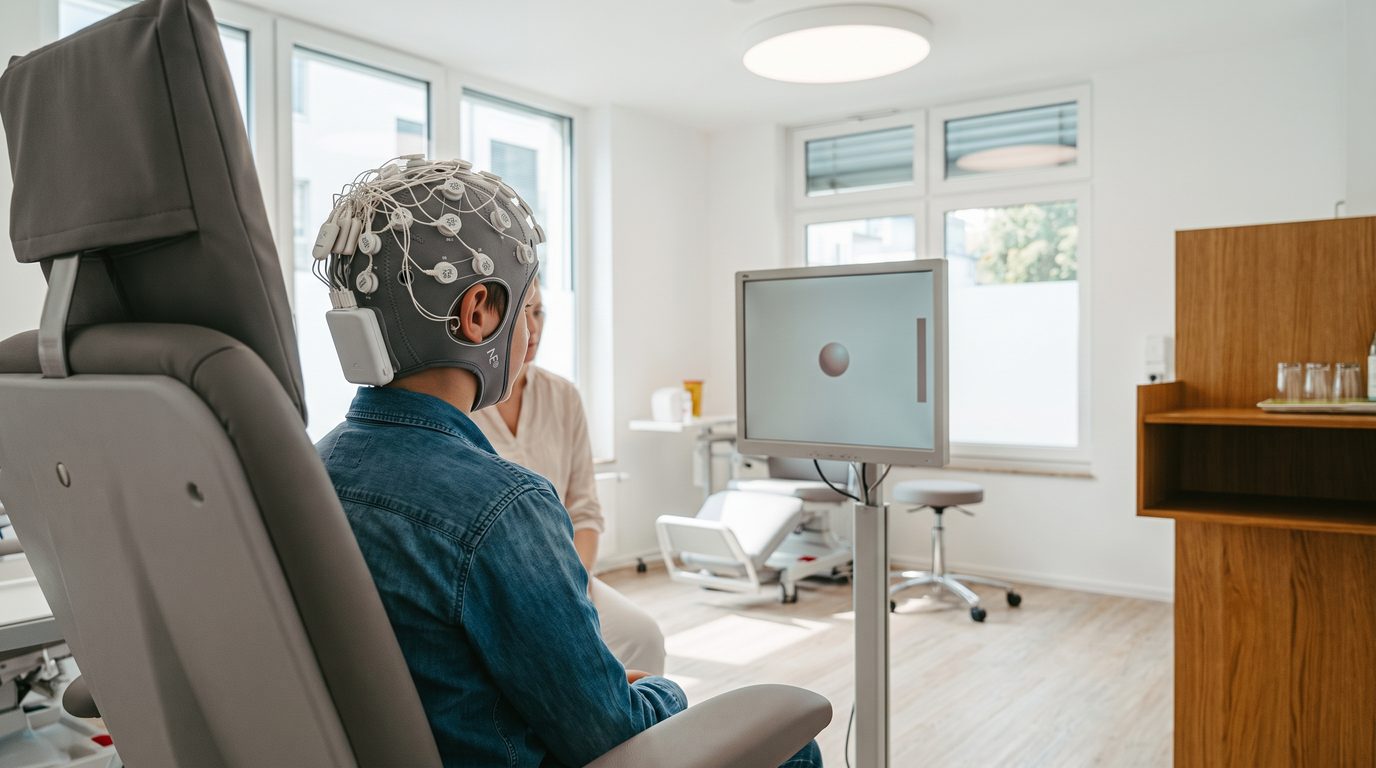
Neurofeedback is a training method in which your own EEG activity is measured and fed straight back to you, through an image, a video or a sound. When brain activity moves in the trained direction, a reward follows on the screen; when it stalls, the screen stays still. In this way the brain learns to regulate a pattern by itself, through the same form of operant learning by which people learn to ride a bicycle. It is non-invasive, and nothing is delivered to the brain.
Our device: Neuroelectrics Enobio 32 (32-Kanal-Wireless-EEG)
The mechanism, made clear
We record the EEG with the Neuroelectrics Enobio 32, a 32-channel wireless EEG with a light cap and a small NECBOX recording unit. The software continuously analyses your brainwaves and drives the feedback from them. Anyone doing neurofeedback with us has qEEG brain mapping first, because what gets trained are the frequency bands or network patterns that stood out there. Neurofeedback trains a pattern; it does not train whatever produces the pattern. Sleep deprivation shifts the EEG towards slow waves, the same picture that is trained in ADHD, and trauma keeps the salience network on permanent watch; that is why sleep diagnostics and psychological support belong in the same plan as the training, and whether neurofeedback is the right building block for you is decided by the assessment.
For us, Neurofeedback is above all a way to regulate functional balance without adding medication — with the aim of restoring function and quality of life.
What to expect
A session lasts 30 to 45 minutes; you wear the EEG cap and watch a screen that responds to your activity. Trying hard does not help; you let it happen. Side effects are rare; occasionally people report brief tiredness or mild tension after a session. What we observe across many trainings: the learning curve differs from person to person. In some the trained band moves after ten sessions, in others after twenty, and in a few only once sleep has been put in order. That is why we combine neurofeedback the way the findings suggest, including where trials of the combination are missing, as an individual, informed treatment attempt, and every learning curve we see changes the next protocol.
We use neurofeedback in ADHD, depression, anxiety, PTSD, in sleep and concentration concerns and for performance optimisation, with progress measurement and usually alongside other building blocks of the plan. Training is outpatient in Bad Aibling, neurofeedback near Munich, about 50 minutes via the A8.
See all conditions — and what fits you is decided by the assessment, with qEEG where the question calls for it.
What the research shows
Peer-reviewed work on Neurofeedback — graded by evidence level. No study proves an individual outcome.
Neurofeedback for attention-deficit/hyperactivity disorder: a systematic review and meta-analysis
EEG neurofeedback treatments in children with ADHD: an updated meta-analysis of randomized controlled trials
Efficacy of portable EEG-based neurofeedback for ADHD: a meta-analysis of randomized controlled trials
Neurofeedback for post-traumatic stress disorder: systematic review and meta-analysis of clinical and neurophysiological outcomes
A randomized controlled study of neurofeedback for chronic PTSD
A randomized, controlled trial of alpha-rhythm EEG neurofeedback in PTSD (with fMRI connectivity)
Biofeedback and neurofeedback for anxiety disorders: a quantitative and qualitative systematic review
A systematic review of EEG neurofeedback in fibromyalgia to treat psychological variables, chronic pain and general health
Meta-analysis of EEG biofeedback in treating epilepsy
Comparative efficacy and acceptability of pharmacological, psychological, and neurostimulatory interventions for ADHD in adults: a component network meta-analysis
More: Science & Studies.
For neurofeedback in ADHD there are meta-analyses and a network meta-analysis, in PTSD and anxiety randomised trials; how much someone benefits depends on protocol, practice time and the person. We choose the protocol from your qEEG and adjust it as the course unfolds.
Part of Clinicum St. Georg, under the medical direction of Dr. med. univ. Julian Douwes. Outpatient, evidence-graded, tailored to your profile. More on our program.
Neurofeedback: is it right for you?
The assessment decides, not a brochure. We clarify it in a free consultation, with no obligation and full confidentiality.