What is neurofeedback?
Your brain learns to regulate itself
Neurofeedback is a training method in which your brain activity is measured in real time and mirrored back to you as an image, sound or game. When the brain produces a more favourable pattern, it receives positive feedback, and through repetition it learns to regulate itself better. No current flows into the brain: neurofeedback trains, it does not stimulate from the outside. That makes it the most patient of our methods, and the one whose result belongs most to you.
Last updated: 2026-07-25 · Medically reviewed by Dr. med. univ. Julian Douwes
The core idea: feedback makes the invisible visible
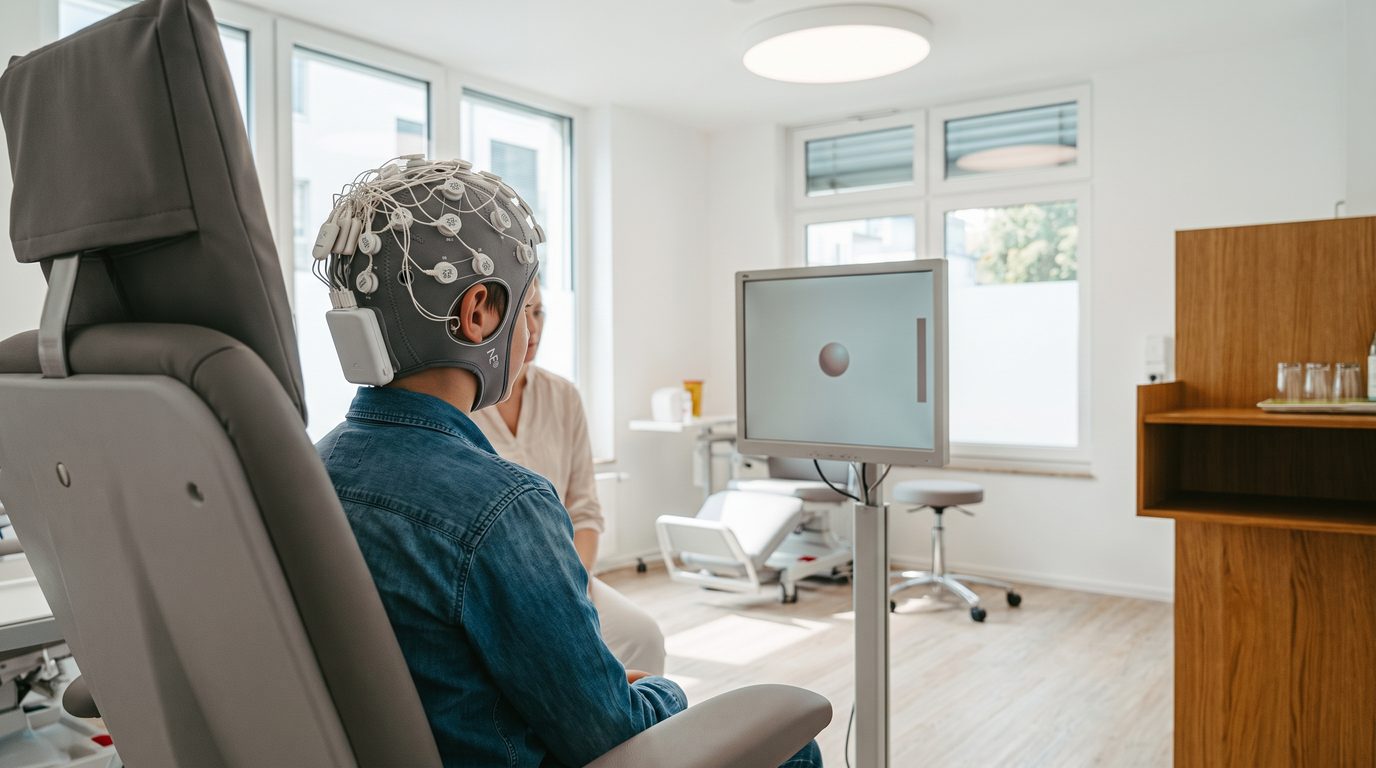
Normally you have no awareness of your own brain activity. Neurofeedback changes that: sensors measure the brain’s electrical waves (EEG) and a computer translates them into something perceptible: a video runs more smoothly, a tone becomes clearer, a character moves.
Behind this is a well-known learning principle (operant conditioning): what is rewarded happens more often. When your brain produces the target pattern, you receive immediate positive feedback. Step by step, the brain learns to produce that pattern more easily, much as a mirror helps you refine a movement.
What does a session look like?
You sit relaxed in front of a screen. Via an EEG cap, in our case a 32-channel wireless EEG (Neuroelectrics Enobio), sensors are placed on the scalp. You do nothing “active”: you watch, listen and let it happen. When the target pattern is reached, the reward (image/sound) continues; when the pattern drifts away, it dims.
A session usually lasts 20–40 minutes. Like any training, the effect shows across several sessions, not after a single one. It is completely non-invasive, painless and without known serious side effects.
Why neurofeedback builds on the qEEG
Meaningful neurofeedback does not guess which pattern to train, it measures first. This is exactly where qEEG brain mapping comes in: it compares your brain activity against a normative database and shows where patterns stand out. From this we derive which region and which wave bands a training should even target.
How this “measure first, then treat” fits into a whole treatment path is shown in Our Program, there, neurofeedback is one building block among others, not a standalone device. To learn more about the qEEG itself, read “What is a qEEG?”.
What can neurofeedback help with?
Neurofeedback is best evidenced for ADHD, where it can help improve attention and self-regulation. Further studied uses with growing evidence include anxiety disorders, PTSD and trauma, and sleep and concentration problems.
The evidence is most solid for ADHD and heterogeneous in other areas; effect sizes and protocols vary. What we offer: a measured, patient training whose protocol we derive from your qEEG profile and adjust as your course unfolds. The current evidence is on Science & Studies, with detail on the neurofeedback treatment page.
Neurofeedback vs. stimulation methods
An important distinction: neurofeedback is a training, not a stimulation method. Methods such as rTMS, tDCS or TPS apply a stimulus to the brain from the outside. Neurofeedback, by contrast, applies no stimulus but mirrors your own activity so your brain learns for itself.
The two can complement each other: stimulation can open a window for change, training can consolidate what is learned. Which combination, if any, makes sense for you follows from your measured profile, not a blanket recommendation.
Frequently asked questions
Does neurofeedback send current into the brain?
No. The sensors only read brain activity; they emit nothing. No current and no magnetic field enters the brain; neurofeedback is pure self-regulation training.
Do I have to actively “get it right” during training?
No, you do not have to strain. You watch and listen; the brain learns largely implicitly through the feedback. That is exactly why it needs repetition across several sessions.
How many sessions do I need?
It depends on the goal and the measured baseline. As with any training, the effect shows over a series of sessions, not after a single one. We discuss a realistic range after your measurement.
Is neurofeedback the same as biofeedback?
Neurofeedback is a specific form of biofeedback focused on brain activity (EEG). Classic biofeedback trains other body signals such as heart rate, breathing or skin conductance. Both rest on the same feedback principle.
Read more
Similar articles
An article does not know your findings.
What fits you is shown by the structured assessment. The free consultation takes 15 to 20 minutes and clarifies whether this path is worth it for you.