You don’t have to explain again
everything you have already tried.
Two people with the same diagnosis rarely share the same brain profile. This page says what we measure for depression, anxiety, OCD or brain fog. The next page says what that means for you, or for the person you are reading for.
You have already tried so much.
One medication, then the next. One therapy, then the wait for the next. At some point the sentence that this is simply how it will be now. Perhaps you are reading for yourself. Perhaps for your husband, your mother, your child.
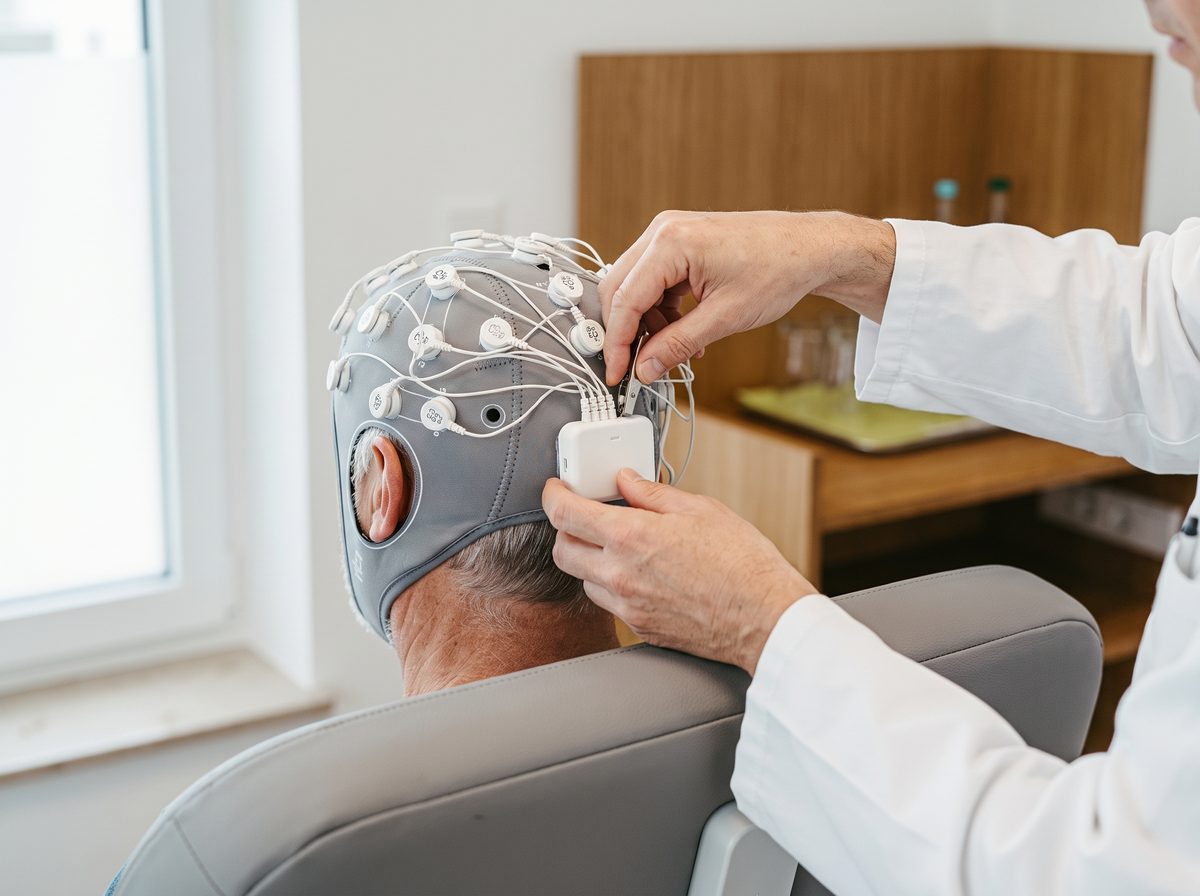
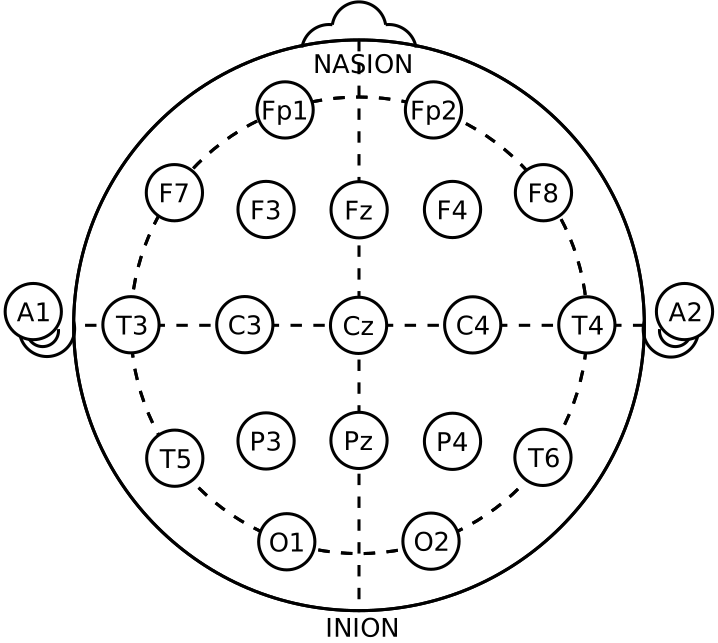
That sentence describes what a method can do. It says nothing about your brain. Everyone who comes to us starts with a structured assessment: history, findings, questionnaires, examination, lab work where it helps. If the question asks for it, a qEEG with 32 electrodes is added and shows which network is out of rhythm. Only then do we talk about methods. Your medication stays as it is unless your treating physicians decide otherwise.

What we measure before we do anything.
Every condition on this page follows the same path. The diagnosis tells us where to look. The assessment tells us what to do.
- Assessment. History, findings, questionnaires, clinical examination, lab work where needed. If the question concerns a network, qEEG brain mapping with 32 electrodes is added: painless, no radiation.
- Your plan. Derived from your findings, with an evidence grade per method, discussed with you.
- Gentle stimulation. Non-invasive neuromodulation, outpatient, next to your ongoing guideline-based care.
- Second set of findings. After treatment we take again what we took before and compare; where a qEEG was recorded, both maps.
Find yourself here.
The conditions are grouped into seven areas so you can find yours faster. Each card carries the evidence grade of the method most often in question there, and leads to the page that says what it means for you.
Mood & Anxiety
When heaviness, fear or intrusive thoughts run your days and you have already tried so much.
Depression
Flat, joyless, exhausted, and you still have to function.
Depression often shows on the qEEG as a pattern: an under-active prefrontal cortex, an over-active default mode network. qEEG brain mapping makes that pattern visible. For depression, rTMS is the best-evidenced non-invasive method; neurofeedback is added depending on the map.
What happens in the brain
Mainly involved are the limbic/emotional network (mood, drive) and an over-active default mode network (rumination), while the executive “manager” network loses momentum. Around 8% of adults experience depression in a given year. A program built on your findings starts exactly there; the Brain Network Analysis offers a first orientation.
Treatment-Resistant Depression
Medication and therapy were not enough. That does not mean you are out of options.
Two adequate medication trials, psychotherapy, and the heaviness stays: guidelines call that treatment-resistant. For exactly this situation rTMS is best studied; the condensed Accelerated TMS protocol is an option. What fits you is decided by the assessment, with a qEEG where indicated, and the conversation that follows it.
What happens in the brain
The same networks as in depression, limbic/emotional, default mode and executive, stay out of balance, often more stubbornly. Roughly one in three depressions does not respond adequately to first-line treatment. A stepped program that follows your findings opens additional avenues.
Anxiety Disorders
A body stuck on high alert that never quite settles.
In anxiety, the salience and limbic networks flag danger too often; how strongly is something a qEEG can show when the assessment calls for one. Then we decide whether neurofeedback, taVNS or rTMS make sense alongside your psychotherapy.
What happens in the brain
The salience network (the “gatekeeper” for what matters) and the limbic network (amygdala) flag danger too often; the body stays on high alert. Anxiety disorders are among the most common mental health conditions (around 14% of adults). A measured program targets better self-regulation; the Brain Network Analysis shows which networks look most taxed for you.
OCD
Thoughts and rituals that will not switch off.
Obsessive-compulsive disorder is exhausting and often under-treated. rTMS holds regulatory clearance for OCD in the US and comes into question when psychotherapy and medication have not brought enough relief; the plan is built on the assessment and your history.
What happens in the brain
The executive and salience networks are involved together with deeper loops; thoughts are assigned too much “importance” and are hard to switch off. About 1–2% of people are affected. What comes into question after the assessment is clarified within your program.
PTSD & Trauma
The event is over. Your nervous system has not caught up yet.
Post-traumatic stress changes how the brain processes threat and memory. Trauma-focused psychotherapy remains the foundation of care; next to it, the assessment, with a qEEG where it is indicated, tells us whether rTMS or neurofeedback can help an over-aroused nervous system regulate.
What happens in the brain
After trauma the salience and limbic networks (amygdala, hippocampus) stay over-aroused while the default mode network falls out of rhythm. That is why the nervous system reacts as if the danger were still present. Next to psychotherapy, a program built on your findings can support regulation.
Bipolar Disorder
Mood swinging between highs and lows, often exhausting.
Learn more & studies →Cognition & Memory
When thinking, remembering, concentration and focus start to slip and the worry behind it grows.
Adult ADHD
A head full of open tabs. Focus that will not hold still.
Adult ADHD frequently goes unrecognised, and stimulant medication is not the right path for everyone. Among non-invasive methods, neurofeedback has the best-documented evidence in ADHD: a training of self-regulation with no electrical stimulus. The qEEG shows your attention pattern and sets what the training targets.
What happens in the brain
The executive and attention networks are affected, while the default mode network does not properly “power down”; focus is hard to hold. Around 3–4% of adults are affected, often unrecognised. Neurofeedback within a program trains exactly this self-regulation; the Brain Network Analysis gives a first orientation.
Alzheimer’s & Dementia
Forgetfulness that is more than age. Function and daily life can still be supported.
In mild-to-moderate Alzheimer’s disease, TPS is CE-certified and photobiomodulation is being researched. The aim is function in daily life. We use both only after prior measurement and informed consent.
What happens in the brain
The default mode network and the memory structures of the limbic network (hippocampus) are affected early. The disease cannot be reversed; the networks that are still there can be stimulated. For that we use TPS and photobiomodulation as part of an overall program.
MCI & Cognitive Decline
The first changes you notice yourself, before others do.
Mild cognitive impairment (MCI) is the stage where taking stock is worth most. A structured assessment, with qEEG brain mapping where indicated, shows where you stand; depending on the findings, neurofeedback, tDCS or photobiomodulation may belong in an overall plan.
What happens in the brain
The first changes appear in the default mode and executive networks, often before routine tests register them. A share of MCI cases stays stable for years. After a baseline, we discuss a program that fits your findings.
Long COVID & Post-COVID (Brain Fog, Fatigue)
The fog in your head that routine tests cannot explain.
Brain fog, fatigue and post-exertional malaise after a COVID infection are measurable, even when routine tests stay unremarkable. We record labs, heart-rate variability and, where the question calls for it, a qEEG, regulate with taVNS, tDCS and rTMS and rebuild with pacing, with as little medication as possible. Microclots and apheresis (Clinicum St. Georg) are named as an important research direction.
What happens in the brain
In “brain fog”, the executive, attention and salience networks in particular run slowed; concentration and switching become hard. The field is actively researched. A program built on your findings bundles the methods that fit; the Brain Network Analysis helps place your symptoms.
Autism Spectrum
Not a deficit but a different way of processing. We work on the burdens that come with it.
Learn more & studies →Pain & Head
When pain or recurring head symptoms have changed how your brain processes signals.
Migraine
Attacks that erase whole days from your life.
Migraine comes with measurable changes in cortical excitability. Alongside guideline-based medical care, non-invasive options such as taVNS and tDCS are being studied for prevention; after the assessment we discuss whether they belong in your overall plan.
What happens in the brain
Migraine involves heightened excitability in the sensorimotor network and a sensitive stimulus control in the salience network. Around 12–15% of people are affected, women more often. Non-invasive procedures are studied as part of an overall concept.
Chronic Pain
Pain that has taken on a life of its own, in the brain too.
Chronic pain involves the brain itself; pain processing can become dysregulated. After a structured assessment, rTMS or tDCS may belong in a multimodal pain concept, never in its place.
What happens in the brain
In persistent pain, processing takes on a life of its own across the salience, sensorimotor and limbic networks; pain “learns itself in”. A program built on your findings belongs next to pain-medical care, never in its place.
Tinnitus
A sound that never stops and no one else can hear.
Tinnitus is generated in the brain’s auditory and attention networks, which is why neuromodulation is an active research field here. The assessment comes first; the evidence for rTMS or neurofeedback in tinnitus is mixed, and we say so before we discuss whether a trial of treatment is reasonable.
What happens in the brain
Chronic tinnitus is generated in the brain: auditory and attention networks stay over-active, and the limbic network keeps the sound “important”. Around 10–15% of adults know persistent tinnitus. Whether rTMS or neurofeedback come into question is clarified in your program.
Fibromyalgia
Pain everywhere that no scan explains, and that is real all the same.
Learn more & studies →Exhaustion & Sleep
When rest no longer restores and your body has fallen out of rhythm.
Burnout
Empty, burned out, and sleep alone stopped helping long ago.
Burnout is exhaustion that rest alone no longer fixes, and it often sits in the autonomic nervous system. The assessment tells stress-related dysregulation apart from depression; from there we build a plan that may include neurofeedback or taVNS alongside structured recovery.
What happens in the brain
Persistent exhaustion affects the salience and limbic networks as well as the autonomic nervous system; the internal stress brake no longer engages properly. A measured program targets better regulation; the Brain Network Analysis gives a first orientation.
Stress & Exhaustion
Chronic stress that leaves measurable traces in the nervous system.
Persistent stress leaves measurable traces in brain activity and the autonomic nervous system. The assessment shows where you stand, with a qEEG when the question calls for it; taVNS and neurofeedback are the methods we discuss most often here.
What happens in the brain
Chronic stress keeps the salience and limbic networks in alarm mode and burdens the autonomic nervous system. What can be measured can be regulated more precisely, within a program built on your findings.
Insomnia & Sleep
Nights without recovery, a mind that will not power down.
A mind that will not power down often has a salience network that stays on alert in the evening. The assessment looks for exactly that, with a qEEG where indicated; depending on the findings, neurofeedback or taVNS may sit next to sleep-medical and behavioural treatment.
What happens in the brain
Often the salience network stays in evening “hyperarousal” and the default mode network will not settle; the mind will not power down. A program bundles non-pharmacological methods for self-regulation.
Infection & Immune System
When an infection has been treated and the nervous system still does not find its way back to balance.
Lyme Disease & Neuroborreliosis
Brain fog, exhaustion and pain after Lyme disease. The neurological partner of the Lyme centre.
Learn more & studies →Advanced Neurological Conditions
The goal is quality of life and function, alongside the neurological treatment you already have.
Parkinson’s
Protecting movement and independence, step by step.
In Parkinson’s disease, our focus is function and quality of life alongside your neurologist’s care. Neuro-physiotherapy is the established pillar; rTMS is being researched as an addition, and we assess it on the basis of your findings.
What happens in the brain
At the center is the sensorimotor network (movement, coordination) with its deeper control circuits. Movement-based therapy is established; additional neuromodulation is assessed on the findings within a program, coordinated with neurology.
Stroke Rehabilitation
After a stroke, back toward function and daily life.
After a stroke, the brain’s capacity to reorganise is the basis of recovery. Neuro-physiotherapy is the established core of rehabilitation; whether tDCS supports the motor training is under study and, for you, decided by the course.
What happens in the brain
Depending on the site of injury, chiefly the sensorimotor and adjacent networks are affected; rehabilitation draws on the brain’s capacity to reorganise (neuroplasticity). A measured program can support motor and cognitive training.
Multiple Sclerosis
Fatigue, gait and function: what can be supported next to your MS therapy.
Learn more & studies →Epilepsy
Next to your specialist care: quality of life and function in view.
Learn more & studies →Huntington’s Disease
Supporting quality of life and daily living, with everything we have.
Learn more & studies →ALS (Amyotrophic Lateral Sclerosis)
Communication, participation, wellbeing: what can be done next to your neurological care.
Learn more & studies →Traumatic Brain Injury
After the injury, back toward focus, drive and daily life.
Learn more & studies →Cerebral Palsy
Targeted support for function, movement and participation.
Learn more & studies →Performance
When you are healthy and want to understand and train your cognitive performance.
Peak Performance
Focus, clarity and resilience, trained on your findings.
Some of our patients are healthy and want to train their cognitive performance. Here too the assessment comes first: a qEEG provides the baseline for the training, and neurofeedback is the primary tool, aimed at what that map shows.
What happens in the brain
Here it is about deliberately training the executive and attention networks: focus, working memory, resilience. On the basis of measurement we discuss a program; the Brain Network Analysis is a first entry point.
What the grade says, and what your findings say.
Every card carries one of three grades. It describes how well a method has been studied for that condition; for rTMS in depression, for instance, there are randomised trials, meta-analyses and regulatory approvals. The grade is a fact about the method. What it means for you is decided in the room, with your findings on the table, with the qEEG where one was indicated, and the conversation that follows. The next step is a free consultation.
Randomised trials and meta-analyses exist for this indication, in some cases regulatory approval too. The method is established here.
The method sits alongside guideline-based care, never in its place. Whether it fits you is decided by the assessment.
First studies, no broad data base yet. We use the method after informed consent and measure the course, so you can see whether it moves anything for you.
A real physician, a real hospital.
The Douwes Brain Center is a brand of Clinicum St. Georg in Bad Aibling, a hospital with more than 30 years of experience, welcoming patients from over 90 countries.
Its Chief Medical Officer is Dr. med. univ. Julian Douwes. He sees your findings and your history before any method is chosen, and talks the approach through with you. The first step is a free consultation; the rest is decided together.
You do not have to decide anything today.
You only have to speak, once, calmly, with someone who listens and measures before they judge. Bring what you have: reports, your medication list, your questions.
Not sure where your situation fits?
Get in touch anyway. In the free consultation we go through your history and tell you plainly whether our assessment would help in your situation and whether a qEEG belongs in it.