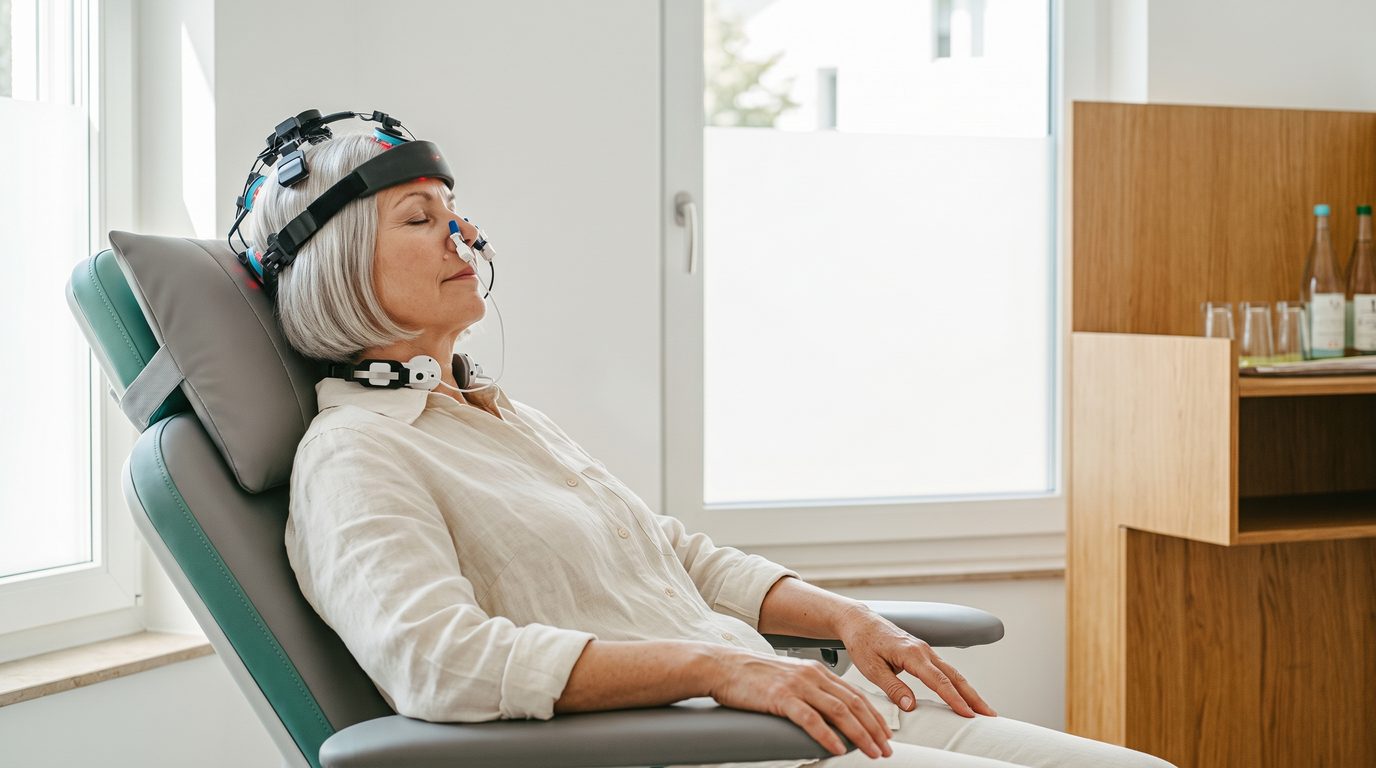
Photobiomodulation –
near-infrared light
for cellular energy
Nerve cells are the most energy-hungry cells in the body. When their mitochondria deliver less after an infection or under chronic stress, the performance of whole networks drops before any scan shows it; that is exactly where near-infrared light acts. The evidence for it is young. Anyone who receives photobiomodulation with us receives it because the assessment points to an energy problem, not because the device is in the building.
Photobiomodulation, on the head also called transcranial photobiomodulation (tPBM), uses red to near-infrared light, typically 630 to 1064 nm, from LED or laser sources. It is neither current nor a magnetic field but light, and part of it passes through scalp and skull into brain regions near the surface. On the brain, photobiomodulation remains experimental, and we offer it as an individual, informed treatment attempt.
Our device: NIR-Gerät (Nahinfrarot-LED/-Laser)
The mechanism, made clear
The main proposed mechanism: near-infrared light is absorbed by cytochrome c oxidase in the mitochondria, the enzyme at which the cell turns its energy into ATP. This can stimulate energy production, support blood flow and dampen inflammatory processes; much of this comes from laboratory and early studies, and the mechanisms are plausible and not yet conclusively proven. In our clinic the NIR device is applied over the regions the assessment suggests, with a qEEG where the question calls for it. With us, photobiomodulation is a building block, and it rarely comes alone: if an infection keeps the immune system running, the mitochondria are working against an engine that keeps going; that is why infection and inflammation diagnostics, micronutrients and sleep belong in the same plan as the light, and the assessment says beforehand whether the light addresses the right place at all.
For us, Photobiomodulation is above all a way to regulate functional balance without adding medication — with the aim of restoring function and quality of life.
What to expect
A session lasts 10 to 20 minutes and is painless. At most you feel a gentle warmth on the scalp; visible red light feels warm, near-infrared is invisible to the eye, and with laser devices you wear eye protection. Serious side effects are rare in studies; you stay awake and continue your day as normal. What we see in use: used on its own, photobiomodulation is a quiet building block. Paired with treatment of inflammation and sleep regulation, we see in a subset of people with Post-COVID exhaustion changes over the course in questionnaires and attention tests, and those are exactly the instruments we use to measure the course. Large trials of the combination are missing; we use it as an individual, informed treatment attempt and document every course.
Photobiomodulation is mainly researched and trialled in cognitive concerns such as mild cognitive impairment and dementia, in depression, after traumatic brain injury and to support cognitive performance, and with us also in the exhaustion that follows infections. It is one part of a measured plan and never the only measure we take.
See all conditions — and what fits you is decided by the assessment, with qEEG where the question calls for it.
What the research shows
Peer-reviewed work on Photobiomodulation (Near-Infrared Light) — graded by evidence level. No study proves an individual outcome.
Brain photobiomodulation therapy: a narrative review
Transcranial photobiomodulation for the management of depression: current perspectives
Transcranial photobiomodulation for neuromodulation of brain disorders: a perspective
PHOTObiomodulation for REsistant Depression: an open-label pilot trial on transcranial photobiomodulation for treatment-resistant depression
Transcranial photobiomodulation improves functional brain networks and working memory in healthy older adults: an fNIRS study
Transcranial photobiomodulation promotes neurological resilience in current collegiate American football players exposed to repetitive head acceleration events
Comparative efficacy and safety of photobiomodulation, tDCS, and rTMS in Alzheimer’s disease: a network meta-analysis of randomized controlled trials
Transcranial photobiomodulation therapy in older women regarding cognitive functions: a systematic review
Differential effects of 808-nm light on electron transport chain enzymes in isolated mitochondria: implications for photobiomodulation initiation
More: Science & Studies.
For photobiomodulation of the brain there are pilot studies, first randomised trials and a network meta-analysis in Alzheimer’s; large efficacy trials are still to come. We use it where your findings point to the energy supply of the nerve cells, and we measure the course alongside.
Part of Clinicum St. Georg, under the medical direction of Dr. med. univ. Julian Douwes. Outpatient, evidence-graded, tailored to your profile. More on our program.
Photobiomodulation (Near-Infrared Light): is it right for you?
The assessment decides, not a brochure. We clarify it in a free consultation, with no obligation and full confidentiality.