Parkinson’s: shaping
quality of life, measurably
Between two visits to your neurologist lie three months of daily life: the nights, the gut, the mood, the fear of the next fall. That daily life can be worked on, in a way that leaves your neurological therapy untouched.
- Free
- No obligation
- Reply within 2 business days
- Outpatient · Bad Aibling
- Non-invasive
Free & non-binding · usually a reply within 2 business days · confidential
Prefer to talk? Call us: +49 (0)8061 398-0
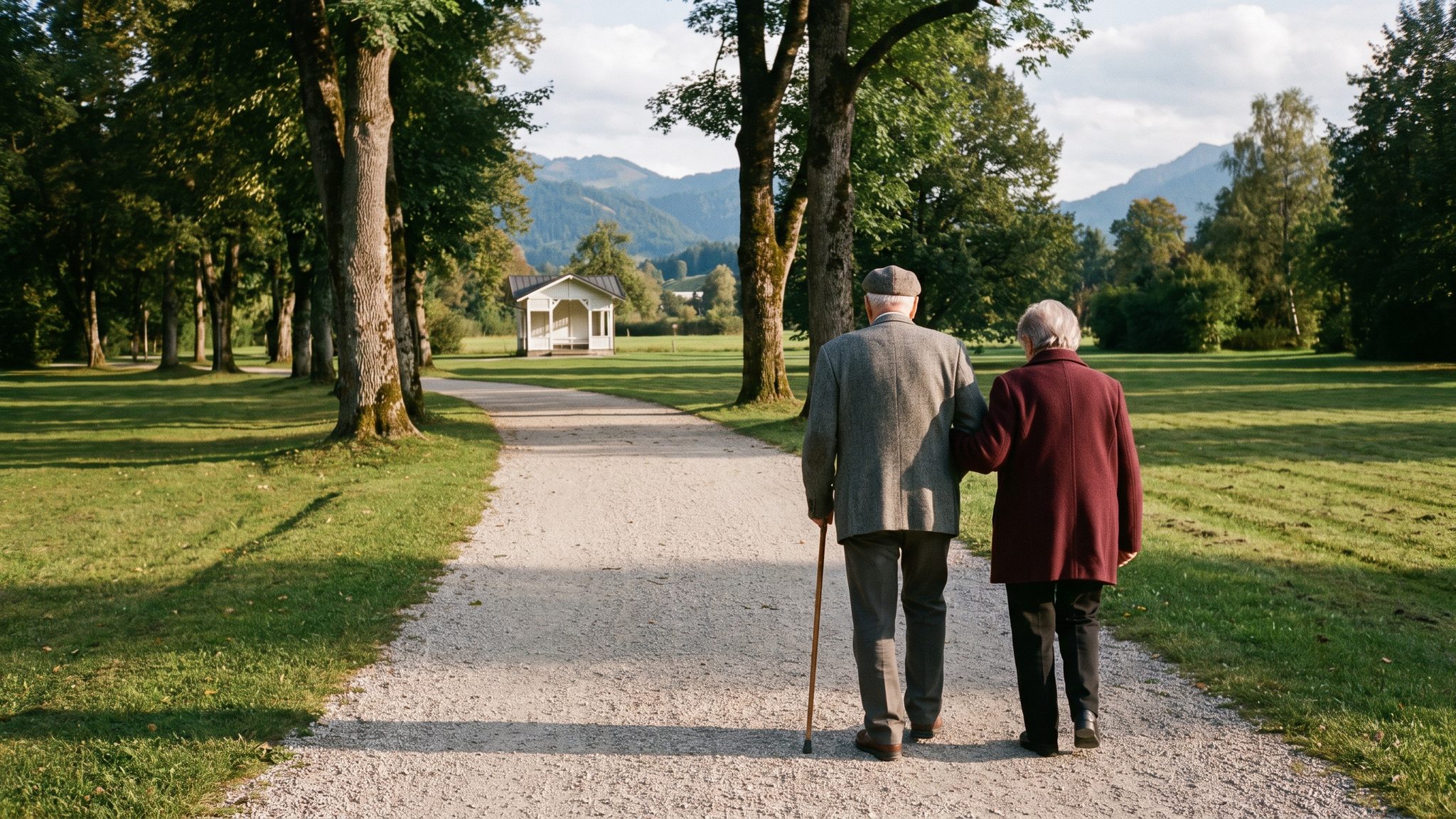
Perhaps you are reading this for your father. The medication is set, and still you see him lying awake at night, the legs refusing in the morning, the way he grows quieter. “We can only slow the course” is a sentence about the disease-modifying therapy. It says nothing about what sleep, movement and a calmer nervous system can still change in daily life.
Parkinson’s is the second most common neurodegenerative disease; around 400,000 people live with it in Germany and over 8 million worldwide.
Are you a family member or carer? You are in the right place too — call or write to us; we support you alongside.
Symptoms have a map
In Parkinson’s the control of movement falls out of rhythm first: dopaminergic signalling in the basal ganglia and the sensorimotor network lose their timing (rigidity, tremor, slowness). Often the limbic network (drive, mood) and the executive network (planning) are involved too. Two systems outside the head play in. The gut: constipation often precedes the diagnosis by years, and gut flora and gut barrier talk to the brain directly through the vagus nerve and inflammatory signals; an irritated gut keeps networks irritated. Sleep: whoever thrashes in REM sleep or lies awake for hours loses exactly the recovery that carries movement and mood the next day. So we treat gut and sleep in the same plan as the movement network.
For an overview of the six brain networks and a first orientation, see the Brain Network Analysis.
Alongside your neurological care: what can be done for everyday life.
Every patient starts with a structured assessment: your neurological findings and current medication plan, questionnaires on sleep, mood and digestion, a clinical examination of gait and balance, lab work where needed. A qEEG is added when mood, drive or cognition is the main question. From this we build a complementary program that adds to your neurological care and involves your neurologist: rTMS for depressive symptoms and slowness, tDCS for gait and fine motor control, taVNS for vagus, gut and sleep, neurofeedback, and physiotherapy that turns what was learned into steps. Your Parkinson’s medication stays as it is unless your neurologist decides otherwise. Bring the latest doctor’s letter and the medication plan to the first consultation.
Our aim stays the same: to restore functional balance, with as little medication as possible and a life with high quality of life as the measure.
You don’t have to decide anything today. A 15 to 20 minute conversation is enough to know whether an assessment is worth it for you.
Free & non-binding · usually a reply within 2 business days · confidential
Who it is for, and who it is not for
A good fit if …
- Medication or therapy has not been enough so far
- You are looking for a measurement-based, non-invasive path
- You are open to outpatient treatment in Bad Aibling
Less suitable if …
- You expect a purely remote or online treatment without on-site diagnostics
- You expect a guarantee — serious medicine cannot give one
In an acute crisis or having suicidal thoughts? Please seek immediate medical or emergency help — in Germany call 112, or the free 24/7 helpline Telefonseelsorge 0800 111 0 111.
The first consultation is free. We discuss the scope, duration and cost of any program openly afterwards, outpatient, here in Bad Aibling.
What the research shows
Peer-reviewed work on Parkinson’s and the relevant procedures, graded by evidence level. No study proves an individual outcome.
In short: for some procedures the evidence is solid, for others still early. Where your case stands is settled in the assessment, and the program follows from it.
rTMS and theta-burst stimulation on motor symptoms in Parkinson’s (network meta-analysis)
Intermittent theta-burst stimulation for depressive symptoms in Parkinson’s (RCT)
tDCS and motor function in Parkinson’s (systematic review + meta-analysis)
Transcutaneous auricular vagus nerve stimulation for motor and gait performance in Parkinson’s (meta-analysis)
Resistance training and quality of life in Parkinson’s (systematic review + meta-analysis)
Exercise for quality of life, cognition and sleep in Parkinson’s (systematic review + meta-analysis)
More studies across all conditions: Science & Studies.
A network meta-analysis of rTMS and theta-burst for motor symptoms and a randomised trial of iTBS for depressive symptoms show measurable effects in Parkinson’s; these methods do not stop the disease from progressing. What changes for your father we check against a gait test, a sleep diary and a mood questionnaire, and after the first block we decide with him whether to continue.

A real doctor. A real clinic.
Dr. med. univ. Julian Douwes · Medical Director
Part of Clinicum St. Georg, under the medical direction of Dr. med. univ. Julian Douwes. Outpatient, evidence-graded, without medication as the first step — tailored to your profile. More on our program.
- 30+ Years of clinical heritage
- 90+ Countries patients travel from
- 30,000+ Treatment sessions delivered
In three calm steps
Parkinson’s: let’s talk about your path.
In a free consultation we clarify whether and how our measured program could fit you — no obligation, fully confidential.
Free & non-binding · usually a reply within 2 business days · confidential