tDCS –
gentle direct current
for a better balance
“You will have to live with it” is, in chronic pain, a sentence about the limits of tablets. Pain that has persisted for years without a matching finding is processed in brain networks, and the excitability of those networks can be shifted with a weak direct current, without medication and without anaesthesia. tDCS is the gentlest tool we have for that; whether it fits your findings is shown by the assessment.
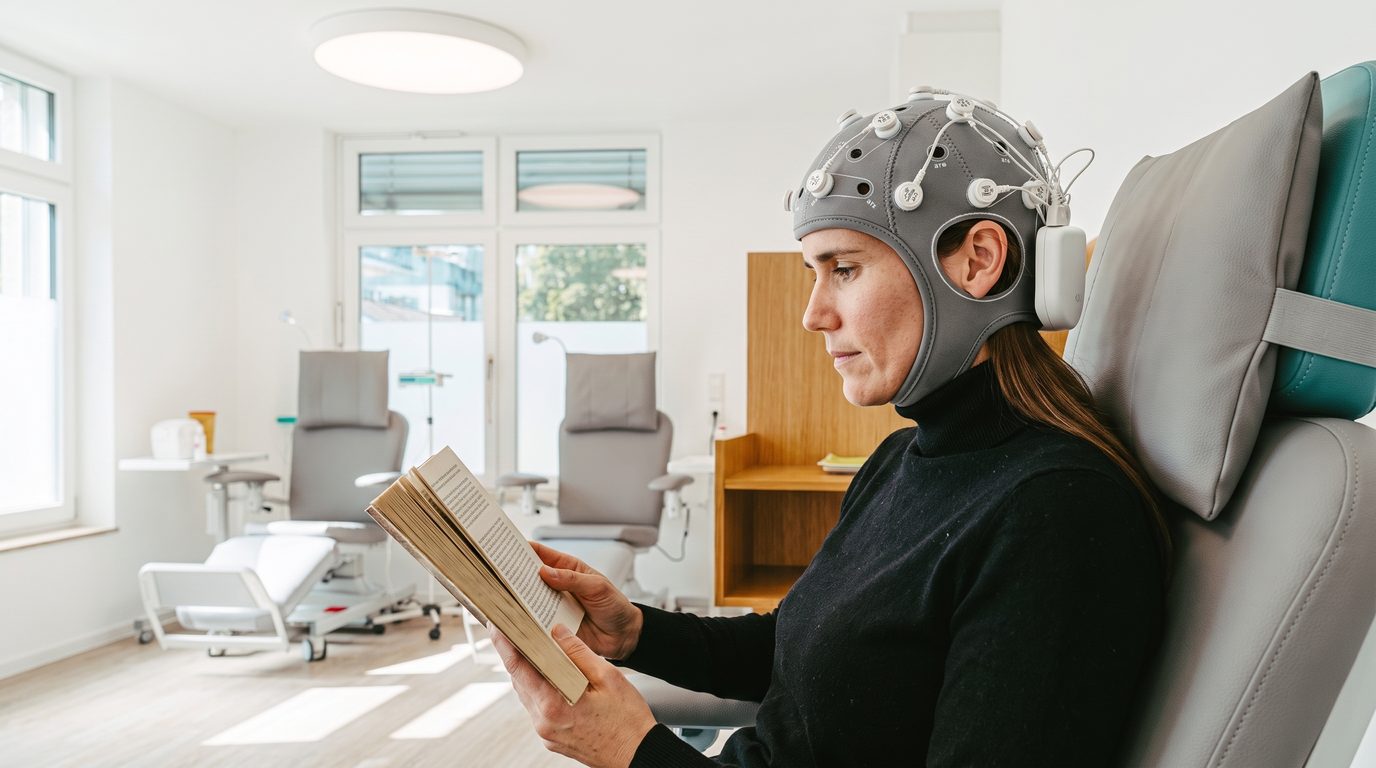
tDCS stands for transcranial direct current stimulation. A very weak direct current, usually 1 to 2 mA, flows through two moistened electrode pads on the head. It causes no muscle twitches and no seizures; unlike the stronger magnetic stimulation, tDCS does not make nerve cells fire directly, it only shifts how ready they are to become active. That gentleness is the reason you can read or do an exercise during the session.
Our device: Elektroden-Pads (Konstantstrom-Stimulator)
The mechanism, made clear
Under the anode (positive pole) nerve cells become easier to excite, under the cathode (negative pole) they are slightly dampened. This lets us push or calm a brain network that has fallen out of balance, for example the motor cortex in chronic pain or the dorsolateral prefrontal cortex in mood and concentration concerns. Where the pads go follows from the assessment, with a qEEG where the question calls for it. With us, tDCS is a building block, and in pain rarely the only one: chronic pain keeps the sympathetic nervous system on permanent tension and breaks up sleep, and both lower the pain threshold further; that is why we measure heart rate variability alongside, take sleep into the plan and let the assessment decide whether the current or something else comes first.
For us, tDCS is above all a way to regulate functional balance without adding medication — with the aim of restoring function and quality of life.
What to expect
A session lasts 20 to 30 minutes; you sit relaxed, read or do an exercise. At the start many people feel a light tingling or itching under the pads that fades after a short while. Possible side effects are skin redness, mild tingling, rarely headache or tiredness; you stay awake and go straight back into your day. For most indications tDCS is not part of standard care; we use it as an individual, informed treatment attempt. What we observe in our pain patients: in chronic pain the pain diary changes under tDCS in a subset of patients, and more often where the sessions were paired with movement and sleep regulation, as the fibromyalgia trial with exercise also suggests. So we combine the way the findings suggest, and we learn from every course.
We use tDCS in depression, chronic pain and fibromyalgia, among others, and alongside training in stroke rehabilitation, Parkinson’s and ADHD. Bring your pain diary to the first consultation if you keep one; it is the baseline against which we measure the course.
See all conditions — and what fits you is decided by the assessment, with qEEG where the question calls for it.
What the research shows
Peer-reviewed work on tDCS (Transcranial Direct Current Stimulation) — graded by evidence level. No study proves an individual outcome.
Transcranial direct current stimulation for acute major depressive episodes: meta-analysis of individual patient data
Efficacy of transcranial direct current stimulation for depression: individual patient data meta-analysis
Transcranial electrical stimulation in treatment of depression: a systematic review and meta-analysis
Efficacy and safety of tDCS on multiple health outcomes in neurological disorders: an umbrella review of meta-analyses of RCTs
Comparative efficacy of non-invasive brain stimulation for pain, anxiety, and depression: a systematic review and network meta-analysis
Dose-response effects of transcranial direct current stimulation on upper-limb recovery after stroke: a systematic review and meta-analysis
Site-specific effects of transcranial direct current stimulation on motor function in Parkinson’s disease: a systematic review and meta-analysis
The efficacy and safety of transcranial direct current stimulation in patients with ADHD: a systematic review and meta-analysis
Dual-site transcranial direct current stimulation combined with exercising improves fatigue and sleep quality in people with fibromyalgia: a randomized sham-controlled clinical trial
More: Science & Studies.
Individual patient data meta-analyses show effects of tDCS in depression, and in chronic pain network meta-analyses show moderate effects, smaller than for rTMS. Where the electrodes go and what is treated alongside the current follows from your findings.
Part of Clinicum St. Georg, under the medical direction of Dr. med. univ. Julian Douwes. Outpatient, evidence-graded, tailored to your profile. More on our program.
tDCS (Transcranial Direct Current Stimulation): is it right for you?
The assessment decides, not a brochure. We clarify it in a free consultation, with no obligation and full confidentiality.