Is rTMS painful? What you feel, and what you don’t
Anyone facing a first rTMS session usually has two questions: does it hurt, and is it safe? Most people answer the first one themselves after session one: it is unfamiliar, not painful. You feel a rhythmic tapping on the scalp, hear a clicking sound and stay awake the whole time. The most common side effect is a mild headache afterwards that fades after the first sessions. The second question we settle before the first session, with a contraindication check that leaves nothing out.
Last updated: 2026-07-25 · Medically reviewed by Dr. med. univ. Julian Douwes
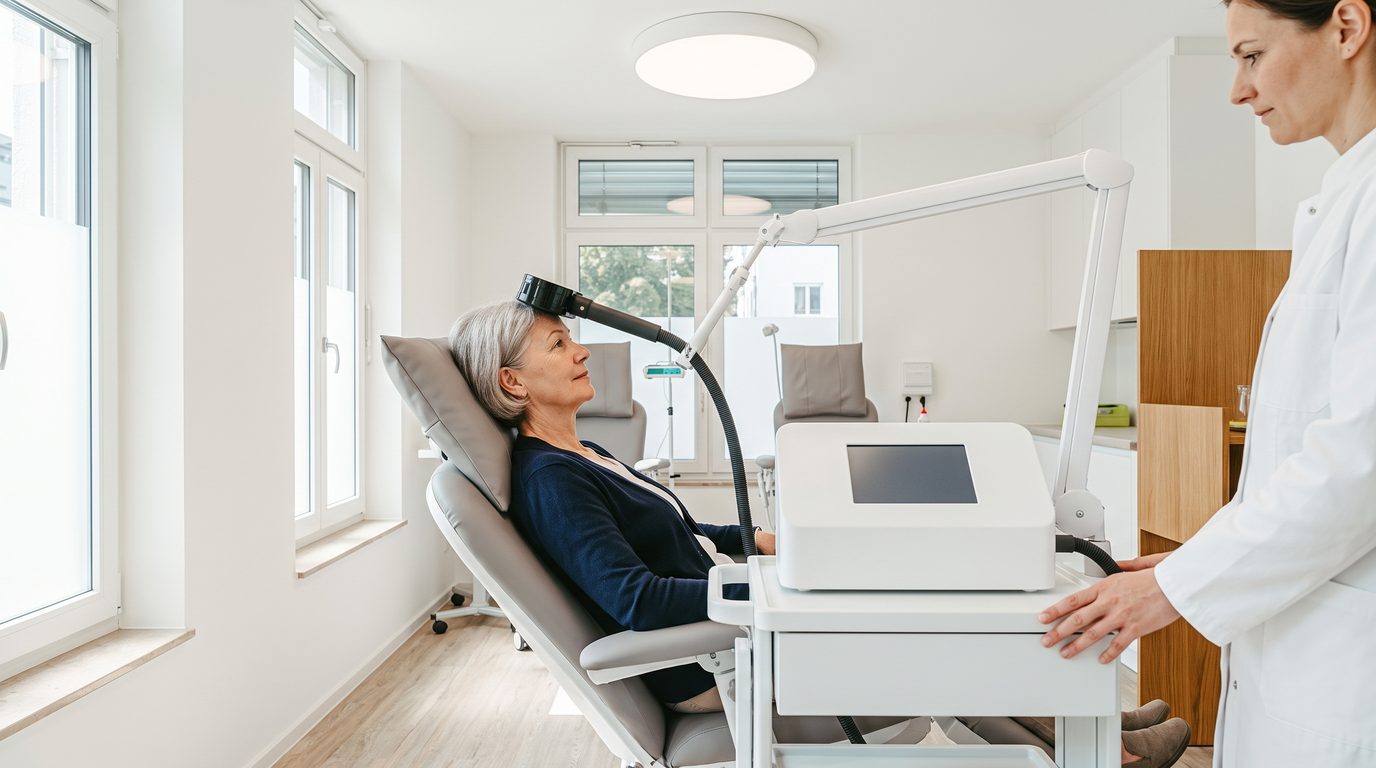
What does an rTMS session feel like?
You sit comfortably in a treatment chair, the magnetic coil resting against the outside of your head. Once the pulse trains begin, you feel a tapping or tapping-tingling on the scalp, rather as if someone were rhythmically tapping with a finger. Alongside this you hear a clicking sound, against which you wear ear protection.
In some people the forehead or facial muscles under the coil twitch slightly. This is normal and harmless, though it can feel unfamiliar in the first few minutes. As a rule people get used to it within the first sessions. Very few report pain in the true sense, more often an intense but well-tolerable sensation.
You can read more about the procedure on our rTMS page.
The most common side effects
rTMS is among the well-studied neuromodulation methods, and the typical side effects are mild and temporary:
- Headache right after the session – usually mild and well controlled with a simple painkiller.
- Scalp tenderness or a feeling of tension where the coil rested.
- Slight twitching of the facial muscles during the pulses.
- Rarely, brief light-headedness or tiredness.
These complaints usually ease after the first sessions, because the body gets used to the stimulation. Afterwards you can resume your day immediately – driving, working, everything as usual.
How safe is rTMS really?
rTMS is a non-invasive procedure: no surgery, no anaesthesia, no medication. It should not be confused with electroconvulsive therapy. The rarest but most serious risk is a seizure – with proper use this occurs very rarely (well below one in a thousand treated people in large safety reviews).
This is precisely why we carefully review your history before starting, follow established safety guidelines and work under the roof of Clinicum St. Georg. We set out the current evidence and safety status transparently for you – more on our research page.
Who is rTMS not suitable for?
Some people should not receive rTMS, or only after especially careful consideration. This applies in particular to:
- Metallic implants in the head/neck region (e.g. aneurysm clips, cochlear implants, certain stimulators) – magnetic fields and metal do not mix.
- A pacemaker or other active implants near the head.
- A known epilepsy or an increased risk of seizures.
We always clarify these points before the first treatment. We never decide whether rTMS is suitable for you in a blanket way, but only after the assessment and a medical conversation. That is exactly what the free consultation is for.
Why we measure first
We do not use rTMS on the off chance. Before the first session comes a structured assessment: history, existing findings, questionnaires, clinical examination. Whether qEEG brain mapping is added to locate the affected network depends on the question. Only then do we decide which region and which protocol make sense, or whether another treatment fits better.
This approach raises the chance that the treatment suits you, and it raises safety: we stimulate in a targeted, dosed way rather than broadly. How well you respond shows in the course. That is why we measure first and follow it closely.
Frequently asked questions
Does rTMS hurt?
Will I get a headache after the treatment?
Is rTMS dangerous?
Am I awake during the treatment?
When should I not have rTMS?
Read more
Similar articles
An article does not know your findings.
What fits you is shown by the structured assessment. The free consultation takes 15 to 20 minutes and clarifies whether this path is worth it for you.