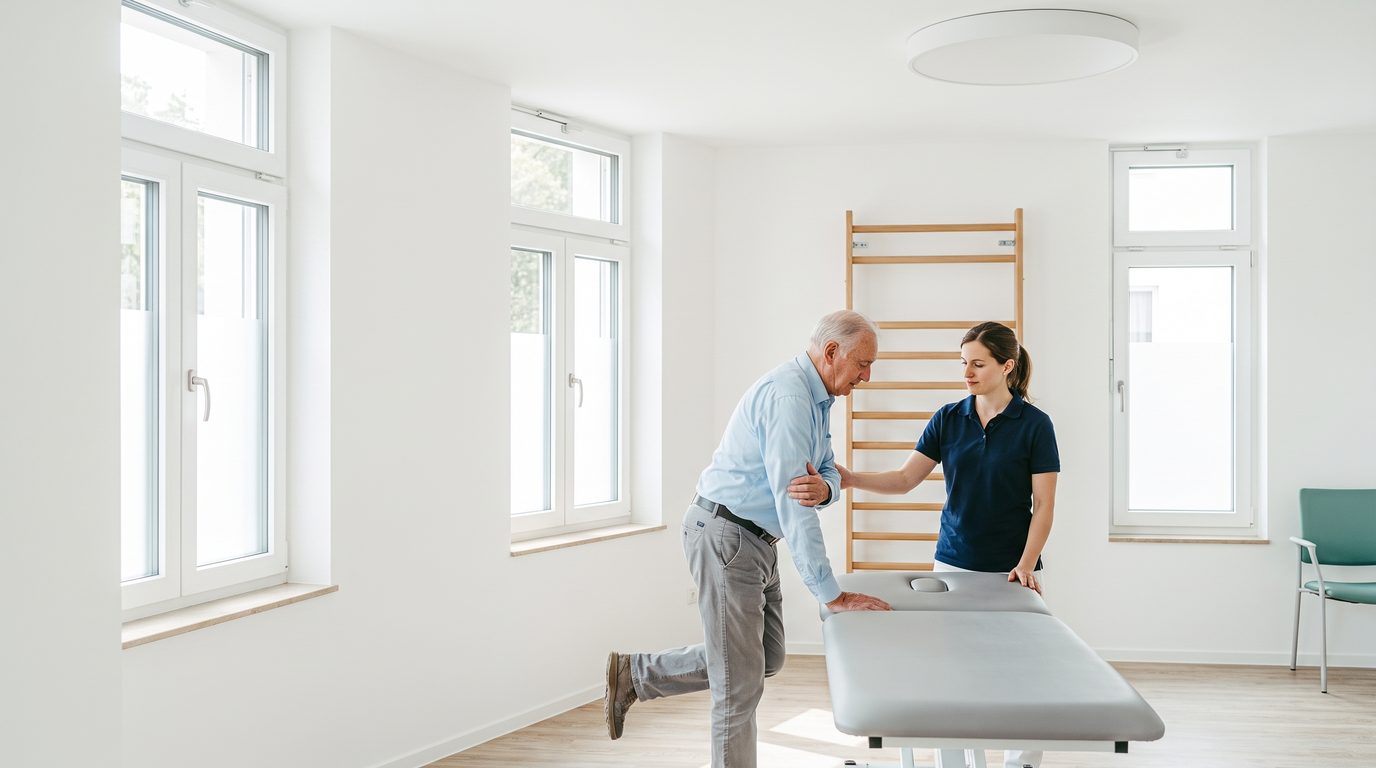
Neuro-physiotherapy –
reaching the brain
through movement
The window for recovery after a stroke does not close with the end of rehab; in studies, people in the chronic phase still gain with sufficiently intensive training. Neuro-physiotherapy uses the ability of the brain to reorganise movement, through task-based practice in high repetition counts. With us it is the building block that translates what stimulation sets off in the network into walking, grip and balance.
Neuro-physiotherapy is the branch of physiotherapy specialised in the nervous system. It does more than strengthen muscles: it trains the connection between brain, spinal cord and movement, for people after stroke, with Parkinson’s, multiple sclerosis or after a traumatic brain injury. It is the movement-based, active part of our program, and the only one in which you do the work yourself.
The mechanism, made clear
The mechanism is neuroplasticity: through task-specific, sufficiently frequent practice, the sensorimotor network (motor and sensory cortex, cerebellum) learns to reorganise movement. Proven principles are task-oriented training, high repetition counts, gait and balance training and, in one-sided paralysis, forced use of the affected side (constraint-induced movement therapy). With us, physiotherapy is a building block we couple with neuromodulation: when rTMS or tDCS makes a network more receptive, practice anchors what has been learned. And a person after a stroke whose depression goes untreated practises less; that is why mood and drive, sleep and the load the heart and circulation can take belong in the same plan as gait training, and the assessment sets what comes first.
For us, Neuro-Physiotherapy is above all a way to regulate functional balance without adding medication — with the aim of restoring function and quality of life.
What to expect
A session lasts 30 to 60 minutes and is adapted to your level, from first guided movements to demanding gait, strength and balance training. It should challenge without overwhelming; mild muscle soreness and fatigue are normal. Your therapists keep aligning the exercises with what you want to be able to do again in daily life: the stairs, the coffee cup, the walk to the bakery. What we observe in therapy: in Parkinson’s and after stroke, gait and balance still change under regular training years after the event, and more clearly where mood and sleep were treated alongside. That is why we couple the training with neuromodulation and supporting treatment the way the findings suggest, as an individual, informed treatment attempt whose course we measure with you.
Neuro-physiotherapy is a core building block for function and quality of life in stroke, Parkinson’s, multiple sclerosis and after traumatic brain injury. In advanced neurological conditions it aims at function, safety and independence in daily life and complements your neurological care; your medication is never changed without your treating physicians. Bring your most recent neurological report to the first consultation.
See all conditions — and what fits you is decided by the assessment, with qEEG where the question calls for it.
What the research shows
Peer-reviewed work on Neuro-Physiotherapy — graded by evidence level. No study proves an individual outcome.
Effect of exercise-based interventions on stroke rehabilitation: an umbrella review of systematic reviews and meta-analyses
Recent highlights in motor recovery and rehabilitation research after stroke
Systematic review and meta-analysis of the efficacy of shorter duration modified constraint-induced movement therapy (mCIMT) programs
Sustained effects of physiotherapy interventions on balance, gait, and general motor function in patients with Parkinson’s disease: a systematic review and meta-analysis
Physiotherapy interventions for balance impairments in Parkinson’s disease: evidence from a systematic review and dose-response meta-analysis
Effects of physical exercise on spasticity in people with multiple sclerosis: a systematic review
Effects of aquatic therapy on fatigue, mobility, physical function, and quality of life in people with multiple sclerosis: a systematic review and meta-analysis
Early multimodal motor training after stroke promotes motor recovery and whole-brain structural remodeling
The effect of exercise interventions on physiological fitness, physical and cognitive function, common symptoms, and disease impact for people with severe multiple sclerosis: a systematic review
More: Science & Studies.
For task-oriented, sufficiently intensive training after stroke and in Parkinson’s, umbrella reviews and meta-analyses show measurable effects on function, gait and balance. We set the goals with you, and the training follows your findings rather than a standard plan.
Part of Clinicum St. Georg, under the medical direction of Dr. med. univ. Julian Douwes. Outpatient, evidence-graded, tailored to your profile. More on our program.
Neuro-Physiotherapy: is it right for you?
The assessment decides, not a brochure. We clarify it in a free consultation, with no obligation and full confidentiality.