The Default Mode Network:
your brain’s “inward” network
The Default Mode Network (DMN) is a set of brain regions that becomes most active when you are not focused on the outside world: when you reflect on yourself, remember, or let your mind wander. When it falls out of balance, this often shows up as rumination, looping thoughts or a feeling of “standing beside yourself”. If that sounds familiar, this network is probably involved, and qEEG brain mapping can make it visible when the question calls for it.
Last updated: 2026-07-25 · Medically reviewed by Dr. med. univ. Julian Douwes
What is the Default Mode Network?
The Default Mode Network was discovered when researchers noticed that certain brain regions become more active, not less, at rest, when a person is not doing anything in particular. Hence the name “default mode”: the setting the brain returns to whenever no external task is at hand.
It is not a single spot but a network of cooperating regions. Simplified, it is the network of self-reference: it produces your inner experience, the thread of your life story and the quiet background hum of thought. To see how all six networks interact, read our overview “The six brain networks explained”.
What does the DMN do – and which regions belong to it?
The DMN takes part in some of the most human of mental processes:
- Self-reference – thinking about yourself, your feelings and values.
- Autobiographical memory – retrieving memories and weaving them into a story.
- Daydreaming and imagination – travelling mentally into the past or future.
- Social cognition – putting yourself in someone else’s shoes.
Its core hubs include the medial prefrontal cortex, the posterior cingulate cortex and the precuneus. These regions communicate constantly – but a healthy DMN can also step back when needed, so you can focus outward.
What does a dysregulation feel like?
When the DMN falls out of rhythm – too active, insufficiently reined in, or poorly coordinated with other networks – daily life can feel like this:
- Rumination and looping thoughts you cannot switch off.
- Memory gaps or trouble holding the thread.
- Low self-awareness or a sense of “standing beside yourself”, up to dissociation.
- Difficulty focusing outward because attention keeps tipping inward.
Such experiences are not proof of any particular illness. Networks work together, and symptoms almost always arise from an imbalance across several networks. That is why we measure rather than guess.
The DMN and common symptom patterns
An overactive or poorly disengaging DMN has been linked in research to several conditions – as one of many pieces of the puzzle, never the sole cause. Examples: the persistent rumination in depression, the fogginess and “brain fog” of Long COVID, and the dissociation and intrusive memories in trauma and PTSD. This helps explain why two people with the same diagnosis can feel entirely different – their network profiles differ.
How we measure – and can train – the DMN
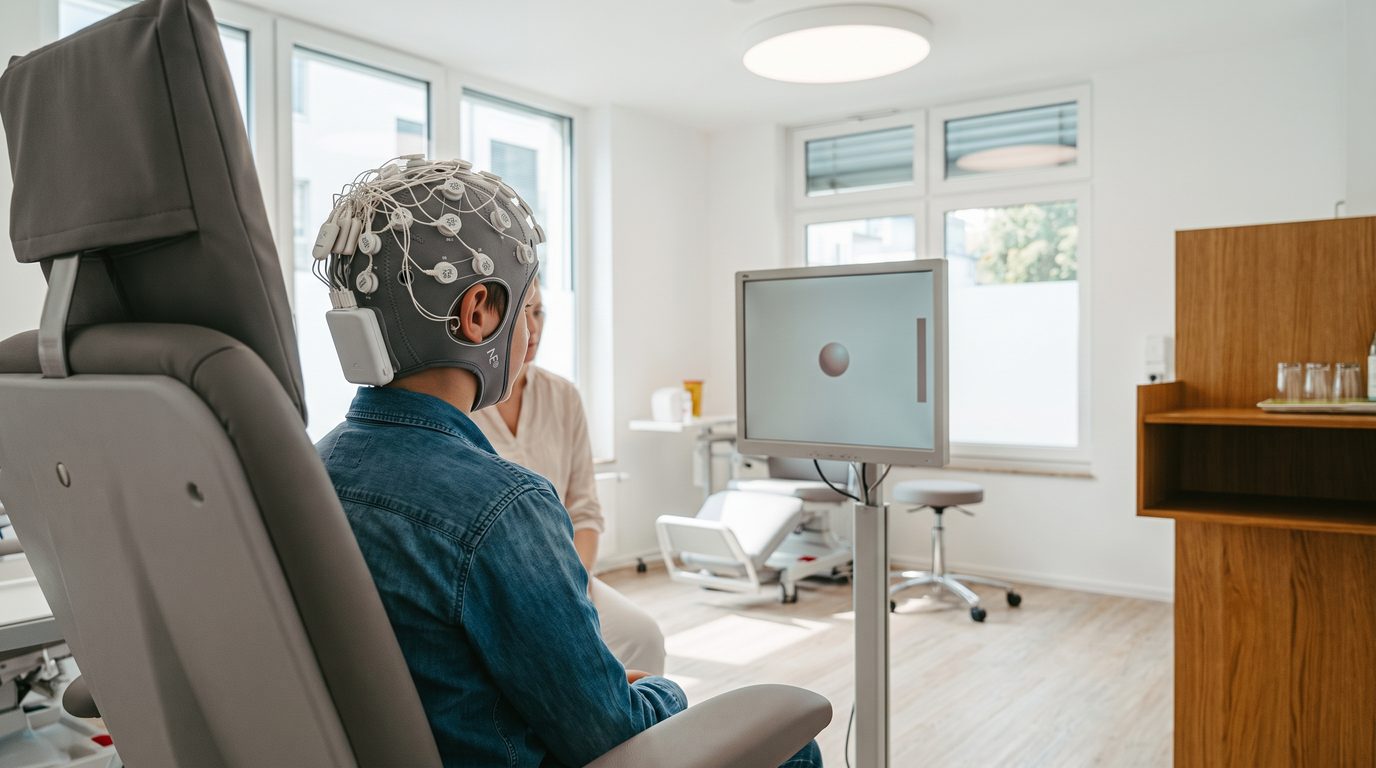
With us, nothing begins with treatment. It begins with a structured assessment: history, existing findings, questionnaires, clinical and neurological examination, and where needed lab work and imaging. Whether qEEG brain mapping is added, comparing your brain activity against a normative database, is decided after that; with rumination, dissociation and concentration problems it often is. Only this whole picture reveals whether, and how strongly, a network like the DMN is involved, and the program is built on it.
If there is a starting point, neurofeedback can help: a self-regulation training in which you receive real-time feedback on your brain activity and learn to calm overactive patterns. For a first, non-binding impression of your network profile, try the Brain Network Analysis.
Frequently asked questions
Is an active Default Mode Network a bad thing?
No. The DMN is healthy and necessary: it enables self-reflection, memory and creativity. What becomes problematic is not its activity but an imbalance, when it no longer steps back to let you focus outward, or fails to coordinate with other networks.
Can I deliberately change my DMN?
Partly. Mindfulness and meditation influence DMN activity, and neurofeedback trains self-regulation directly. Whether this makes sense for you is shown by your findings, not by an article.
How do you determine whether my DMN is involved?
Through a structured assessment: history, questionnaires, clinical and neurological examination, lab work and imaging where needed, and, when the question calls for it, qEEG brain mapping. A physician combines these into one picture; a single test is not enough.
Is the Brain Network Analysis a diagnosis of my DMN?
No. The Brain Network Analysis is a self-assessment tool for orientation, not a medical diagnosis and not remote treatment. What your profile means is clarified in a conversation with your findings.
Read more
Similar articles
An article does not know your findings.
What fits you is shown by the structured assessment. The free consultation takes 15 to 20 minutes and clarifies whether this path is worth it for you.