taVNS for Long COVID & Brain Fog
Transcutaneous auricular vagus nerve stimulation (taVNS) gently stimulates a branch of the vagus nerve via the ear, from the outside and without surgery. In Long COVID and its often burdensome brain fog it is used to calm over-activated stress and inflammatory axes. The vagus nerve is the nervous system’s brake, and in many people it has not been applied since the infection: sympathetic drive permanently up, recovery permanently down. Its use is off-label; this article explains the principle, the process and the evidence.
Last updated: 2026-07-25 · Medically reviewed by Dr. med. univ. Julian Douwes
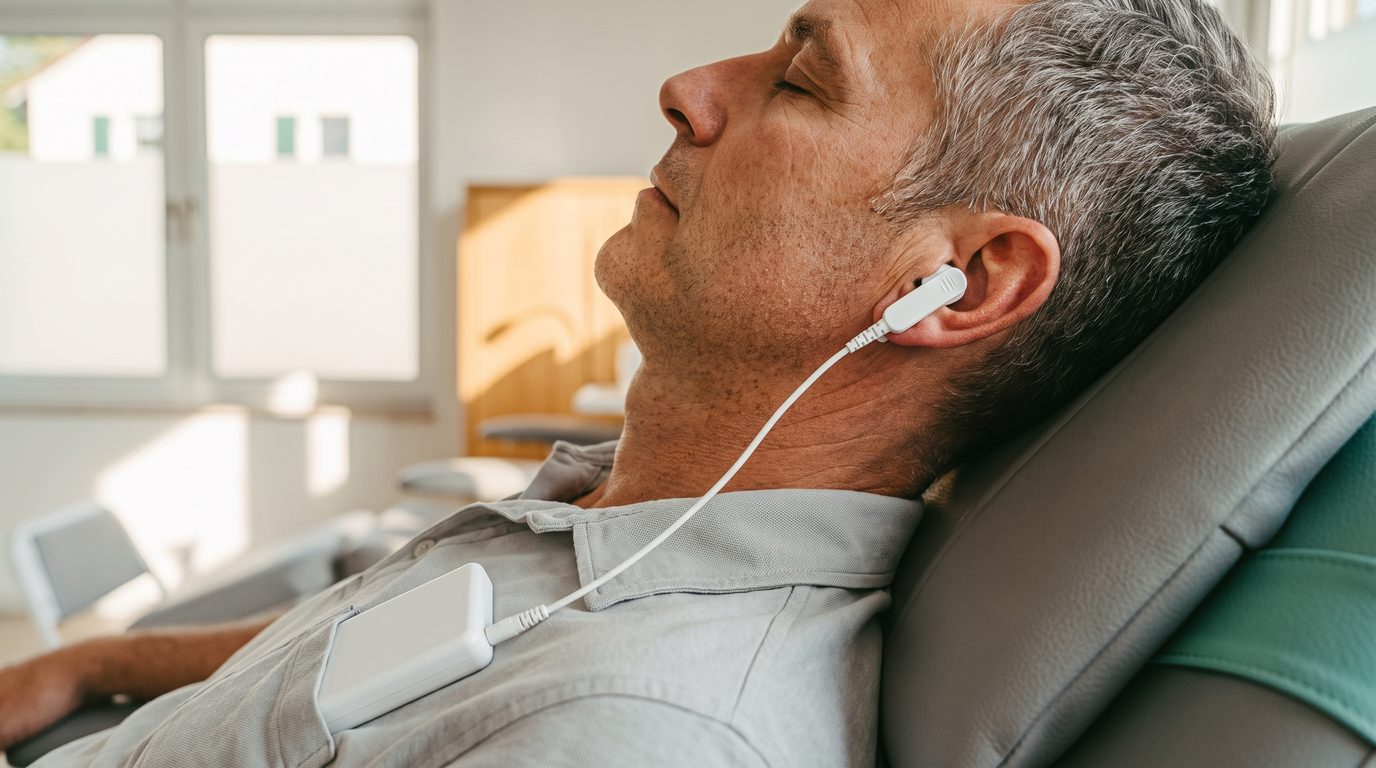
What taVNS is
taVNS uses a small electrode at the ear to gently stimulate a superficial branch of the vagus nerve. The vagus nerve is the central "brake" of the autonomic nervous system: it dampens stress responses and modulates inflammatory signalling. The idea is to down-regulate the over-active stress system via this route, non-invasively and with little discomfort. For an overview of gentle methods see Non-invasive neuromodulation.
Why this is of interest in Long COVID
In Long COVID and brain fog, many people show a mix of exhaustion, difficulty concentrating, inner restlessness and autonomic imbalance. Among the factors discussed are a persistent activation of inflammatory and stress systems and a dysregulation of the autonomic nervous system. Because the vagus nerve sits exactly at this interface, taVNS is a plausible point of leverage to calm the system. Functionally several brain networks are involved, in particular the salience and attention networks.
Off-label, and why that can make sense
For Long COVID there is as yet no procedure with a specific approval for this indication; taVNS is therefore used off-label. Off-label does not mean "untested" but rather: a procedure is used outside its formal approval when it is medically justified and sensible for the individual case. We do not treat the label “Long COVID” but your findings, and taVNS is one building block in that: as long as immune activation or disturbed sleep keeps the sympathetic excess going, stimulation works against a constant trigger. That is why lab work, sleep and, where there are indications, infection work-up belong in the same plan. What off-label means exactly is explained at Off-label treatment explained.
Process & tolerability
A taVNS session is straightforward: a small electrode is placed at the ear, and the stimulation is gentle, set individually so that it feels like a light tingling but stays comfortable. taVNS is considered well tolerated; possible side effects are mild (e.g. local tingling or redness at the ear). Before starting, a physician in our program reviews your diagnostics and checks suitability. In some cases taVNS is a good complement to further building blocks of the program.
Reading the evidence
Research on taVNS is growing, studies exist on inflammation, autonomic regulation and individual symptom clusters, while the specific evidence for Long COVID itself is still young. Overall we rate the evidence as growing to moderate and communicate this openly. Real, linked studies are available at Science & Studies. What we offer: a carefully measured, closely monitored attempt to relieve your system, tailored to your profile. For a first orientation, try the Brain Network Analysis (not a diagnosis).
Frequently asked questions
Is taVNS approved for Long COVID?
Does taVNS help against brain fog?
Is the stimulation at the ear unpleasant?
Can I combine taVNS with other treatments?
How do I begin?
Read more
Similar articles
An article does not know your findings.
What fits you is shown by the structured assessment. The free consultation takes 15 to 20 minutes and clarifies whether this path is worth it for you.