How does TPS work?
Gentle shockwaves for the brain
TPS (transcranial pulse stimulation) uses brief, focused ultrasound shockwaves that pass from the outside through the skull into deeper-lying brain regions. There, the mechanical impulse is intended to trigger cellular processes that support perfusion, cell signalling and neuroplasticity. What sets TPS apart from rTMS and tDCS is reach: the impulse arrives in regions that lie deeper than what a magnetic field or direct current can reach. In Europe, TPS with the Storz Neurolith is CE-marked for Alzheimer’s dementia; other applications are off-label.
Last updated: 2026-07-25 · Medically reviewed by Dr. med. univ. Julian Douwes
What is TPS, and how does it differ from rTMS?
TPS stands for transcranial pulse stimulation. Unlike rTMS (magnetic fields) or tDCS (direct current), TPS uses mechanical energy: very short, focused ultrasound shockwaves. A single pulse lasts only microseconds.
The key difference is reach and focus: whereas magnetic and electrical methods mainly reach regions near the surface, the TPS shockwave can be aimed at a specific point even in deeper regions. For this we use the Storz Neurolith, a device developed specifically for brain application.
The mechanism: mechanotransduction
The core idea is mechanotransduction: cells can translate mechanical stimuli into biochemical signals. When the short shockwave meets the tissue, the cells “sense” the pressure impulse and respond with a cascade of processes. Among those discussed and described in laboratory work are:
- release of growth factors such as VEGF and BDNF, which support vascular and nerve growth;
- release of nitric oxide (NO), which widens vessels and can locally improve blood flow;
- activation of signalling pathways linked to neuroplasticity, the rewiring of nerve cells.
In simple terms: the mechanical stimulus is meant to signal the tissue to activate its own repair and adaptation mechanisms, without surgery and without medication.
What does a session look like?
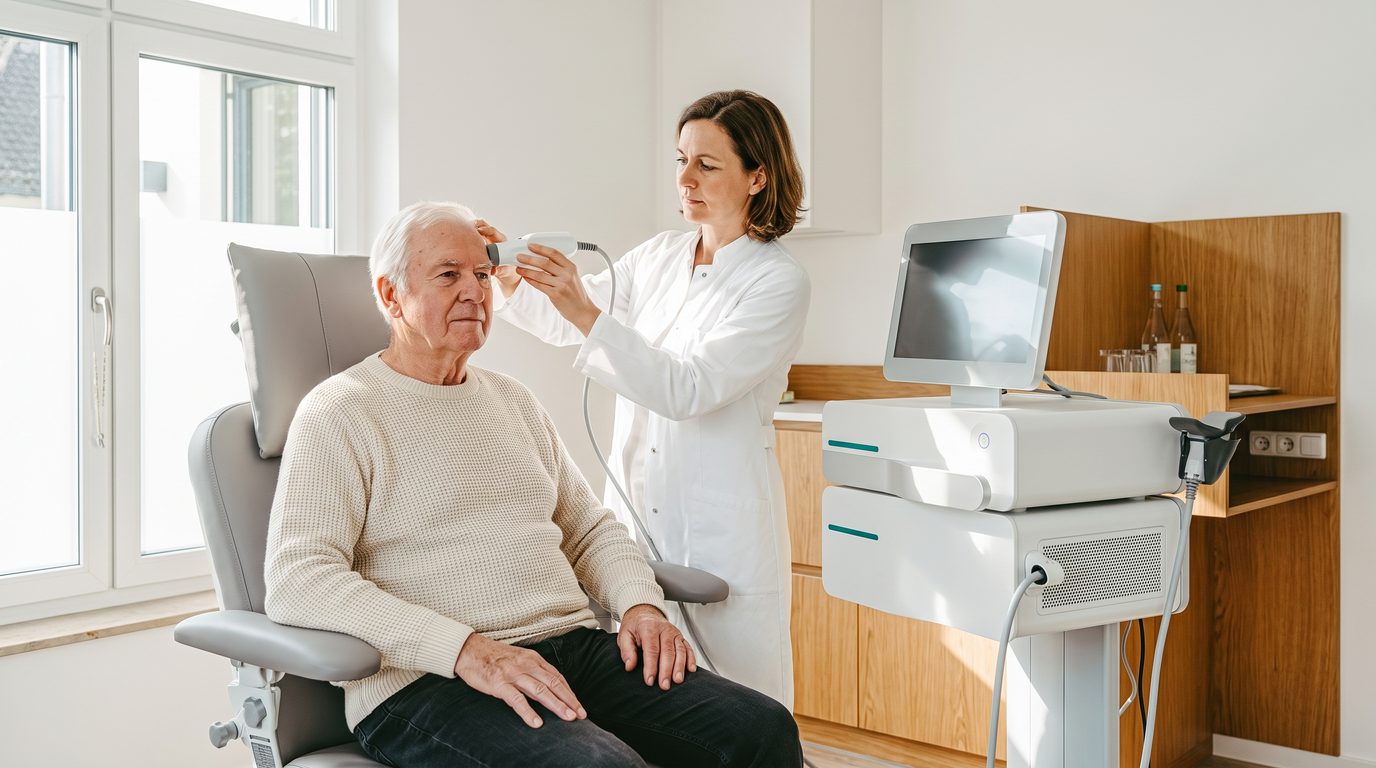
Before the first session, an MRI scan usually serves as a map so the shockwaves can be aimed precisely at the intended target regions. During treatment the applicator is applied with some gel to various points on the head; you feel a light tapping. A session typically lasts around 30–45 minutes.
TPS is outpatient, requires no anaesthesia and is generally well tolerated; occasional temporary headache or a mild pressure sensation are reported. As with all our methods, diagnostics come first, and TPS is embedded as one building block within an individual program, not in isolation as “a device”.
CE-marked for Alzheimer’s, off-label for other uses
In Europe, TPS with the Storz Neurolith is CE-marked for mild-to-moderate Alzheimer’s dementia. For this indication the evidence is most solid and continues to grow. We also use TPS for other indications, but then off-label, that is, outside the formal approval.
Why can off-label still be reasonable? Because the same mechanisms, improved perfusion, neuroplasticity, are relevant across different conditions, and because every network dysregulation is individual. That is exactly what makes standardisation hard: there is rarely “one” protocol for everyone. What this means legally and practically we explain in detail in “Off-label treatment: what it means”.
What TPS can and cannot do
TPS is a complementary, well-tolerated procedure with a plausible mechanistic basis and, for Alzheimer’s dementia, increasingly solid evidence. It is not a cure and does not reverse existing nerve damage. Not everyone responds; how strongly shows in the course, which we document.
TPS is currently most relevant for Alzheimer’s dementia and mild cognitive impairment (MCI). The current evidence, graded by level, is on our Science & Studies page, with further detail on the TPS treatment page.
Frequently asked questions
Is TPS the same as ultrasound at the doctor’s?
It uses the same underlying physics, but differently. Diagnostic ultrasound produces images; TPS delivers very short, focused shockwaves to set mechanical stimuli (mechanotransduction) in the tissue. The aim is stimulation, not imaging.
Do the shockwaves really reach deeper brain regions?
One advantage of TPS is its focusability: the shockwave can be aimed at a point that may lie deeper than the near-surface regions reached by rTMS or tDCS. An MRI map helps target the regions precisely.
Is TPS approved in Germany?
In Europe, TPS with the Storz Neurolith is CE-marked for mild-to-moderate Alzheimer’s dementia. For other indications we use it off-label, with transparent informed consent and embedded in an overall program. More in Off-label explained.
Does TPS hurt?
Usually not. You feel a light tapping on the head. Treatment is outpatient and without anaesthesia; occasional temporary headache or a mild pressure sensation are reported.
Read more
An article does not know your findings.
What fits you is shown by the structured assessment. The free consultation takes 15 to 20 minutes and clarifies whether this path is worth it for you.